Kevin Warsh's Inflation Signal: What the Fed Rate Hike Means
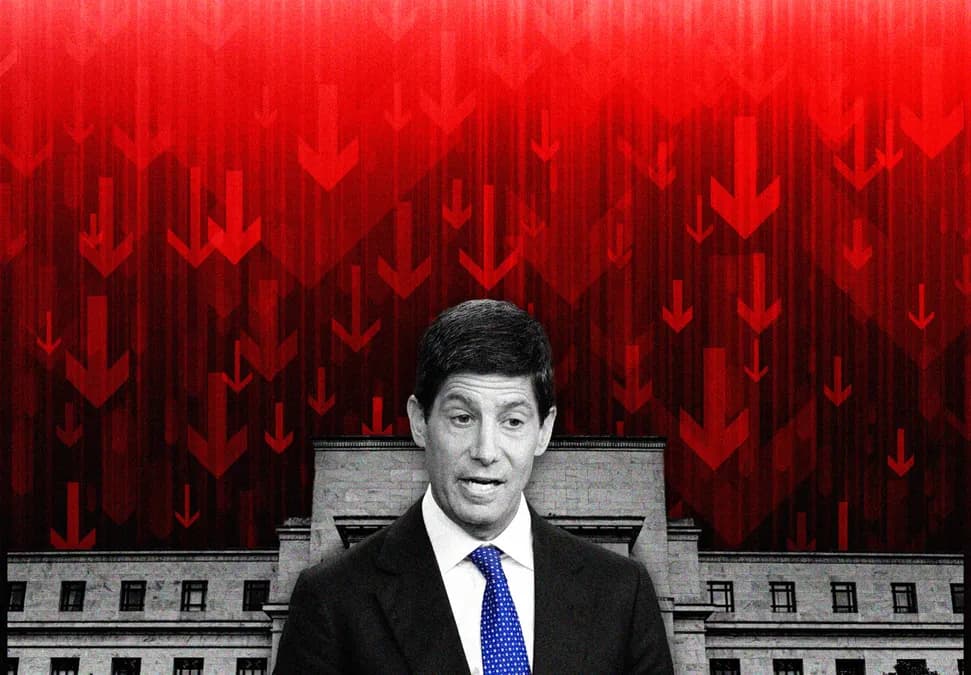
Federal Reserve Chair Kevin Warsh has delivered a blunt message to financial markets: the central bank's commitment to taming inflation is not a posture — it is a policy. The latest Fed rate hike 2026 decision, met with immediate turbulence across equity and bond markets, underscores a Jerome Powell-era lesson that Warsh appears to have internalized fully. Fighting inflation requires a willingness to absorb short-term pain in the service of long-term price stability.
Warsh, a former Fed governor who served on the Board of Governors during the 2008 financial crisis, has long been associated with a hawkish disposition toward monetary policy. His ascent to the chairmanship brought with it a clear intellectual framework: credibility is the Fed's most durable asset, and once surrendered, it is extraordinarily expensive to reclaim. The current tightening cycle reflects that conviction in real time.
The signal embedded in the latest rate decision is not merely about basis points. It is about the Fed's willingness to hold a restrictive stance even as markets push back, even as headlines warn of economic softening, and even as political pressure — historically ever-present around election cycles — mounts. Warsh is drawing a line. The question markets are now wrestling with is precisely where that line ends.
Why the Fed Believes Inflation Still Has Further to Run

The persistence of inflation in the American economy has defied a succession of optimistic forecasts. Data from the Bureau of Labor Statistics has shown that while headline consumer price index readings have moderated from their post-pandemic peaks, core inflation — which strips out the volatile food and energy components — has proven stubborn. The Federal Reserve's preferred gauge, the Personal Consumption Expenditures price index tracked by FRED, similarly reflects an inflation environment that has not yet returned durably to the Fed's 2 percent target.
Read next Altman: OpenAI IPO 'Ill-Advised' in 2026 | AI ValuationsThat gap between where inflation sits and where the Fed wants it matters enormously for policy. The 2022-2023 tightening cycle, which saw the federal funds rate rise from near-zero to its highest level in over two decades, demonstrated that even aggressive hikes require time to transmit through the economy. Credit costs rise. Business investment slows. Consumer spending cools. But the transmission is neither immediate nor linear, and Warsh's Fed appears to be betting that the job is not yet finished.
Economists at institutions including the Brookings Institution have noted that expectations-anchoring is central to the Fed's mission. If households and businesses come to believe that inflation will remain elevated, they will price that expectation into wages, contracts, and spending decisions — creating a self-fulfilling dynamic that becomes far harder to dislodge. The Volcker-era hikes of 1980 and 1981, which pushed the federal funds rate above 19 percent, offer the starkest historical lesson: inflation that is allowed to become entrenched demands a far more painful cure than inflation addressed early and decisively.
Warsh appears acutely aware of that precedent. His public posture suggests a Fed that will not declare victory prematurely. The risk, in his calculus, of easing too soon outweighs the risk of holding restrictive policy a quarter or two longer than strictly necessary.
Market Reaction to the Rate Hike Decision

Markets responded to the Fed's resolve with sharp and immediate distress. The Dow Jones Industrial Average fell approximately 600 points following the rate decision, as investors recalibrated expectations for the path of monetary policy and its implications for corporate earnings, valuations, and debt servicing costs. The selloff was not confined to equities. Bond markets, which had already been pricing elevated rate uncertainty, experienced fresh volatility as yields adjusted to the new policy signal.
Sharp swings of this magnitude are a feature, not a bug, of a tightening cycle in which the Fed is actively reshaping expectations. When a central bank communicates that rates will stay higher for longer than previously anticipated, asset prices across every major class must reprice. Equities that were valued on assumptions of near-term rate cuts suddenly look expensive. Fixed income instruments with longer durations face mark-to-market pressure. The repricing is disorderly because expectations had drifted.
This dynamic is not novel. During the 2022 tightening cycle, the S&P 500 fell more than 25 percent from peak to trough as the Fed rapidly unwound the accommodative stance adopted during the pandemic. Volatility indices spiked. Credit spreads widened. The experience reinforced a lesson that is easy to forget in calmer times: when the Fed changes direction, particularly in a hawkish direction, the reverberations travel widely and quickly.
For market strategists at major financial institutions, the 600-point Dow drop likely represents the opening act rather than the full story. More sharp swings in stocks and bonds should be anticipated as incoming economic data — payrolls, CPI prints, PCE readings — either confirms or challenges the Fed's assessment that inflation remains too high to justify any pivot.
What Investors Should Expect Next from the Federal Reserve
The forward path of the Fed rate hike 2026 cycle depends, as always, on the data. But Warsh has made clear that the burden of proof required to shift policy now rests heavily on the side of disinflationary evidence. A single softer CPI print will not suffice. The Fed will want to see a sustained pattern of price deceleration, accompanied by labor market cooling that does not tip into outright contraction, before it considers any adjustment to its stance.
Investors should expect continued volatility in interest rate-sensitive sectors. Real estate investment trusts, utilities, and other yield-proxy equities will remain under pressure as long as short-term rates stay elevated. Technology stocks, many of which carry long-duration earnings profiles, are similarly vulnerable to upward rate surprises. Sectors with strong pricing power and limited debt exposure — energy, certain industrials, select financials — may offer relatively better shelter, though no asset class is immune to a broad risk-off environment.
The bond market will function as a real-time referendum on the Fed's credibility. If long-term yields continue rising alongside short-term policy rates, it signals that investors believe inflation will remain a persistent problem. An inverted or flattening yield curve, by contrast, would suggest markets expect the Fed's tightening to eventually slow growth sufficiently to bring inflation down. Watching the spread between the two-year and ten-year Treasury yields will remain among the most informative signals available to investors navigating this environment.
Implications for Households and the Broader Economy
Beyond the trading floor, the Fed's sustained tightening posture has direct and tangible consequences for ordinary Americans. Mortgage rates, which track closely to longer-term Treasury yields, remain at levels that have significantly cooled the housing market. A household purchasing a median-priced American home today faces monthly financing costs that are substantially higher than they were three years ago — a compression of affordability that has sidelined many prospective buyers and pressured household formation.
Consumer credit costs have risen proportionally. Credit card rates, auto loan rates, and home equity line rates all move in alignment with the broader rate environment. For households carrying variable-rate debt, each incremental Fed hike translates directly into higher monthly obligations. The consumer spending that drives roughly two-thirds of U.S. GDP is not immune to this pressure indefinitely.
For the broader economy, the tension Warsh is navigating is the classic central banker's dilemma: tighten enough to break inflation, but not so aggressively as to break growth. The Fed's dual mandate — price stability and maximum employment — means the central bank cannot simply optimize for one goal at the expense of the other. A labor market that begins deteriorating sharply would complicate the hawkish narrative considerably.
What Warsh's message signals, above all else, is institutional resolve. The Fed, under his leadership, will not flinch from the inflation fight because markets sell off. That resolve, uncomfortable as it is for investors in the near term, is precisely what credible monetary policy requires. The inflation fight, by all indications, has longer to run.
Source: MarketWatch.com - Top Stories