Warsh Sends a Clear Message on Inflation
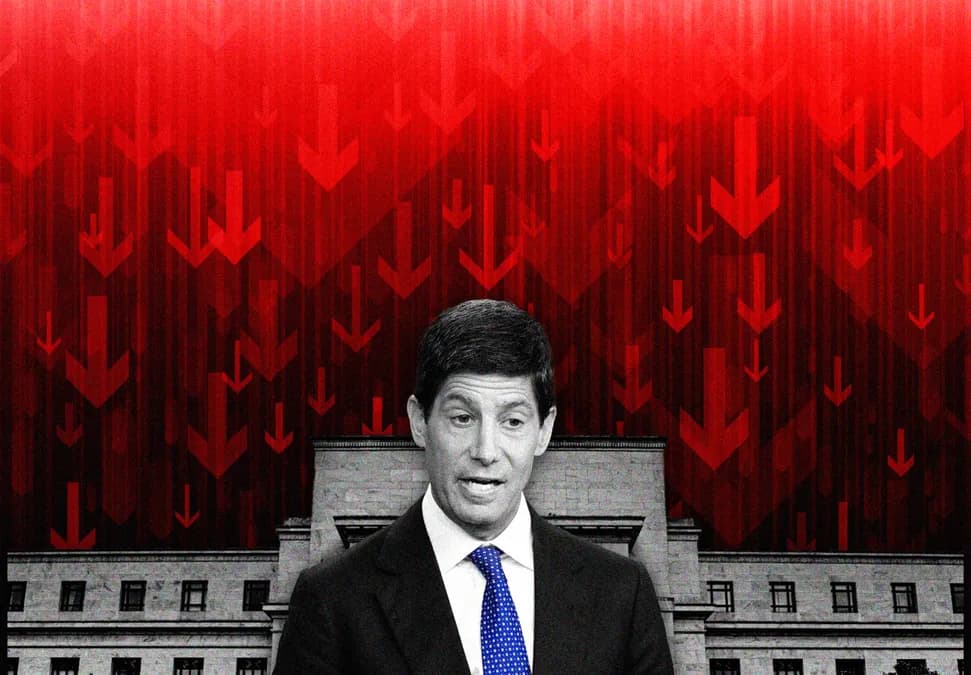
Markets got the message — and they did not like it. Federal Reserve Chair Kevin Warsh signaled in clear terms that the central bank's commitment to reducing inflation is not softening, not pausing, and not open to negotiation. When it comes to the Fed rate hike inflation battle, Warsh is drawing a firm line.
The Dow Jones Industrial Average dropped roughly 600 points in the immediate aftermath, a reaction that reflected investor anxiety more than confusion. Traders understood exactly what Warsh was saying: rates will remain elevated, perhaps longer than Wall Street's base case projected, and the Fed is prepared to accept market turbulence as a cost of restoring price stability. Sharp swings in both equities and fixed-income markets are now the expected backdrop, not an aberration.
Warsh's posture marks a deliberate departure from the kind of ambiguity that often characterizes central bank communication. The hawkish clarity itself carries policy weight.
Why the Fed Believes Inflation Has Longer to Run

Persistent price pressures have repeatedly defied predictions of a quick resolution. The Bureau of Labor Statistics has documented headline Consumer Price Index readings that remain uncomfortably above the Fed's 2% long-run target, while core PCE — the Fed's preferred inflation gauge — has proved sticky, particularly in services categories that are less sensitive to interest rate changes than goods.
Read next Altman: OpenAI IPO 'Ill-Advised' in 2026 | AI ValuationsHousing costs, insurance premiums, and labor-intensive service sectors have all contributed to what economists describe as "embedded" inflation. Unlike a supply-shock spike that resolves once supply chains normalize, embedded inflation reflects expectations: businesses price in anticipated cost increases, workers demand wage growth to offset purchasing-power losses, and the cycle reinforces itself. Breaking that cycle is precisely why the Fed rate hike inflation strategy requires duration, not just magnitude.
Warsh's framing — that the fight has longer to run — acknowledges this structural reality. The Fed is not simply responding to data prints; it is attempting to shift inflation expectations themselves. That is a slower, more difficult task than raising rates to a specific terminal level and waiting.
How Markets Are Interpreting the Fed's Resolve

The 600-point Dow decline is a symptom of a repricing process, not a panic. Fixed-income markets moved in tandem, with yields adjusting to reflect a higher-for-longer rate environment. When the Fed signals sustained restrictiveness, the yield curve responds: shorter-dated Treasuries track the policy rate closely, while longer-dated yields incorporate growth and inflation expectations over time.
Fixed-income strategists have noted that the curve's behavior during prolonged tightening cycles typically compresses corporate borrowing capacity and widens credit spreads on lower-quality debt. In practical terms, that means companies relying on cheap refinancing face a genuine squeeze. Equity valuations built on discounted cash flow models are directly sensitive to rate assumptions — higher discount rates compress the present value of future earnings, which is why growth stocks tend to suffer disproportionately when the Fed doubles down.
The volatility forecast embedded in Warsh's message is not incidental. It is partly intentional. A Fed that communicates credible commitment to fighting inflation accepts that risk assets will reprice. A wealth effect in reverse is, in this framework, a feature rather than a bug: tighter financial conditions help transmit monetary policy into the real economy.
What a Prolonged Rate Hike Cycle Means for Investors
Investors navigating this environment face a more complex calculus than in prior cycles. The conventional wisdom — that bonds provide ballast when equities fall — has been repeatedly tested when inflation drives both asset classes lower simultaneously. Duration risk in bond portfolios becomes a genuine concern when the Fed rate hike inflation cycle extends further than consensus expected.
For equity investors, sector rotation matters more than index-level positioning. Energy, financials, and short-duration value stocks historically outperform during tightening cycles relative to long-duration growth plays. Cash and short-term instruments yield meaningfully positive real returns in an environment where the Fed has raised rates substantially, reversing years of financial repression.
Real assets — commodities, infrastructure, inflation-protected securities like Treasury Inflation-Protected Securities (TIPS) — offer partial hedges, though their performance varies depending on whether inflation is driven by demand or supply dynamics. The current environment contains elements of both, complicating the hedge.
The key discipline for investors: avoid the assumption that the first sign of rate stability signals an imminent pivot. Warsh has explicitly indicated that inflation reduction is his mandate, not market stability.
Historical Context: When the Fed Commits to the Fight
The clearest parallel remains the Volcker era. Paul Volcker, appointed Fed Chair in 1979, faced an inflation rate that had reached double digits and an economy where price expectations had become deeply unanchored. His response was aggressive: the federal funds rate climbed toward 20% by mid-1981. The resulting recession was severe — unemployment peaked above 10% — but inflation was broken. By 1983, CPI had fallen from nearly 15% to below 4%.
Volcker's approach demonstrated a principle that Warsh appears to be applying today: credibility requires consistency. Half-measures that pause prematurely allow inflation expectations to re-entrench, forcing an even more painful adjustment later. The initial market reaction to Volcker's tightening was similarly turbulent — stocks fell, bond yields spiked, and calls for a policy reversal were intense.
The lesson is not that every tightening cycle requires Volcker-era extremity. It is that a Fed committed to its inflation mandate must be willing to absorb short-term market and economic pain. Markets that believe the Fed will blink at the first sign of financial stress will not fully tighten financial conditions on their own. Warsh's messaging is, in part, designed to foreclose that assumption.
What Comes Next: Outlook for Rate Policy and Inflation
The trajectory depends on how quickly price pressures respond to accumulated tightening. If services inflation begins to moderate as labor market conditions cool, the Fed may find it can hold rather than continue hiking — a plateau rather than an extended ascent. That distinction matters enormously for asset prices and borrowing costs.
However, Warsh's stated resolve suggests the Fed will not declare victory prematurely. The risk of a false pivot — easing before inflation is durably contained — outweighs, in the Fed's current assessment, the risk of overtightening. That asymmetry shapes policy choices at the margin.
Expect continued volatility in stocks and bonds as the market recalibrates around a sustained high-rate regime. The Fed rate hike inflation commitment signals that the central bank prioritizes long-run price stability over short-run market comfort. Warsh has drawn his line. The fight, as he sees it, still has distance to run.
Source: MarketWatch.com - Top Stories