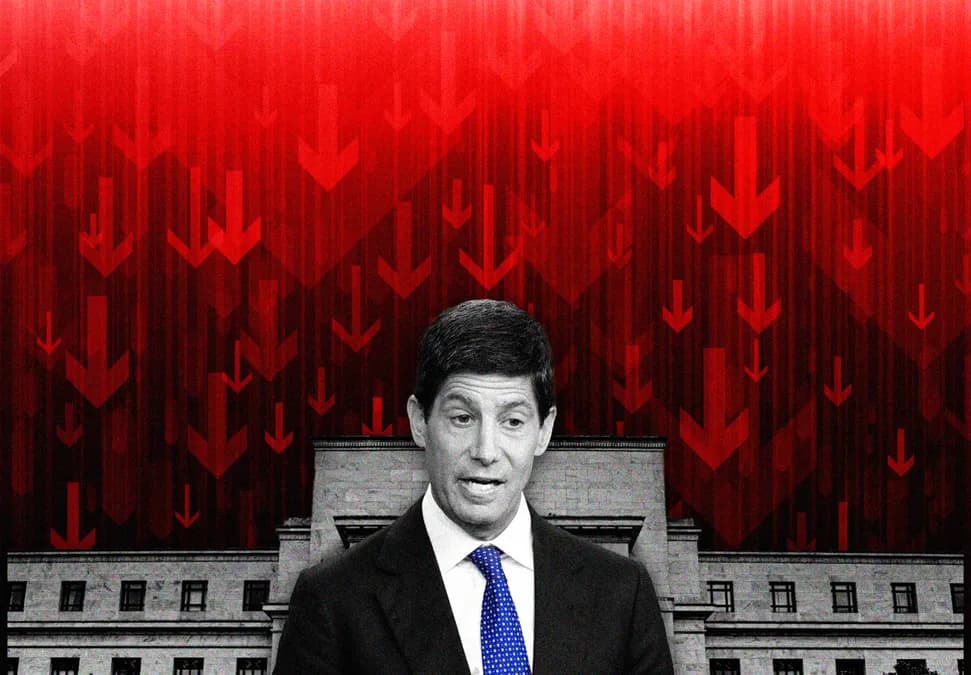
Federal Reserve Chair Kevin Warsh has delivered a message that Wall Street cannot afford to misread: the central bank's commitment to bringing inflation under control is unconditional, and the path back to price stability will not be shortened by market discomfort. For investors who had hoped the Fed might pivot quickly toward rate cuts, that message carries real weight.
Warsh Draws a Hard Line on Inflation
The Fed's 2% inflation target has remained out of reach for an extended stretch. According to Bureau of Labor Statistics data, the Consumer Price Index ran above 3% on an annual basis well past the initial tightening cycle that began in 2022, illustrating just how stubborn price pressures can be once they embed themselves in wages, rents, and service costs. Warsh, now at the helm, has made clear that the central bank will not relent until inflation is durably back at target — not merely trending in the right direction.
That distinction matters. A central bank can declare premature victory and pay a steep credibility cost when inflation re-accelerates. Warsh appears determined to avoid exactly that outcome. His signals suggest the Fed rate hike inflation strategy currently in place prioritizes credibility over short-term market comfort — a stance that echoes some of the most consequential monetary policy decisions in modern American history.
Why the Fed's Inflation Fight Has Longer to Run

Inflation's persistence is not an accident of bad luck. The Federal Reserve's preferred inflation gauge, the Personal Consumption Expenditures price index tracked by the Bureau of Economic Analysis, spent more than two years running above 4% before beginning a gradual descent. Even as headline readings improved, core inflation — which strips out volatile food and energy prices — proved far stickier, particularly in services categories tied to labor costs.
Read next Altman: OpenAI IPO 'Ill-Advised' in 2026 | AI ValuationsThis dynamic explains why Warsh's posture is cautious rather than celebratory. When inflation becomes entrenched in expectations, the Fed must do more than adjust nominal interest rates. It must convince households, businesses, and bond markets that higher rates will persist long enough to actually change behavior. That credibility cannot be purchased with a single rate hike or a single hawkish speech. It must be earned over time.
The Federal Reserve Economic Data (FRED) repository maintained by the St. Louis Fed shows that periods when PCE inflation exceeded 3% for more than 18 consecutive months have historically required sustained tightening to resolve. The current episode fits that pattern. Warsh, by all indications, has absorbed that lesson.
Market Reactions and Investor Takeaways

Markets do not always reward clarity. When investors receive a signal that rate relief is distant, equities frequently sell off, credit spreads widen, and rate-sensitive sectors reprice sharply. That dynamic has played out before, and the current environment is no different.
The Dow Jones Industrial Average has experienced sharp sessions on Fed-related news, reflecting the degree to which equity valuations had been built on assumptions of lower financing costs. Those assumptions are now being stress-tested. For investors who positioned for an early pivot, the recalibration is painful. For those who understood that the Fed's credibility required a longer fight, the volatility — while unpleasant — is legible.
Institutional investors with exposure to long-duration assets face particular scrutiny. When the terminal rate stays higher for longer, the discount rate applied to future cash flows rises, compressing the present value of growth stocks and long-maturity bonds simultaneously. That simultaneous pressure across asset classes is precisely what makes this phase of the cycle especially challenging to navigate.
What Warsh's Approach Means for Stocks and Bonds
Rate policy at this stage of the tightening cycle creates asymmetric pressure across asset classes. In equity markets, sectors with high sensitivity to borrowing costs — real estate, utilities, and capital-intensive industrials — typically underperform as rates rise or remain elevated. By contrast, financials, particularly banks with floating-rate loan books, may find a degree of support from a higher-rate environment.
The bond market tells a more complex story. Short-duration Treasuries benefit from elevated yields, offering investors income that had been absent for much of the post-2008 era. Long-duration bonds, however, remain exposed to upward repricing if markets conclude the Fed's tightening will persist beyond current consensus expectations. A scenario in which the 10-year Treasury yield rises further would place additional pressure on mortgage rates, corporate borrowing costs, and leveraged buyout economics.
Credit markets are also adjusting. High-yield spreads — the premium investors demand above risk-free rates to hold lower-quality corporate debt — tend to widen when recession risk increases. If sustained rate hikes slow growth meaningfully, default probabilities rise and credit conditions tighten, creating a feedback loop that the Fed must weigh carefully against its inflation mandate.
How Long Could the Inflation Fight Last?
History offers a sobering benchmark. Between 1979 and 1982, then-Fed Chair Paul Volcker raised the federal funds rate to nearly 20% to break an inflation spiral that had persisted throughout the 1970s. The campaign worked, but not without consequence: the U.S. economy endured two recessions in quick succession, unemployment climbed above 10%, and borrowing costs reached levels that devastated the housing and auto sectors.
The Volcker episode is cited by economists not as a model to replicate, but as evidence that restoring price stability after a prolonged inflation surge demands extraordinary resolve. Research published by economists at the Federal Reserve Bank of San Francisco and elsewhere has documented how expectations-anchoring — convincing the public that the central bank will follow through — is often the decisive variable. Credibility, once lost, is expensive to rebuild.
Warsh's approach suggests he is acutely aware of this historical record. Even if the current tightening cycle does not approach Volcker-era magnitudes, the strategic logic is similar: demonstrate resolve early and consistently, so that households and businesses adjust behavior without requiring the Fed to tighten beyond what the economy can absorb.
Economists debate how long that process takes under current conditions. Former Fed Governor Frederic Mishkin has written extensively on how inflation expectations can become de-anchored even at relatively moderate price levels if the central bank signals ambivalence. Warsh appears to be signaling the opposite.
What Investors Should Watch Next
Several indicators will clarify whether Warsh's hard line is sufficient or whether additional tightening lies ahead. Monthly CPI and PCE releases remain the primary scorecards. Sustained deceleration in core services inflation — historically the most persistent component — would be the most credible evidence that the Fed's stance is working.
Labor market data carries equal weight. The Fed's dual mandate includes maximum employment alongside price stability, and a meaningful rise in the unemployment rate would introduce tension into the policy calculus. The relationship between job growth and inflation, as captured by measures like the Employment Cost Index published by the Bureau of Labor Statistics, will shape how aggressively the Fed continues pressing.
Fed communications — minutes, speeches, and the Summary of Economic Projections — will also reward close reading. Any shift in the median "dot plot" projection for the terminal rate, or language adjustments in post-meeting statements, can move markets quickly.
For investors, the takeaway is straightforward even if the environment is not: Warsh has drawn a line, and until inflation data gives him clear reason to step back from it, that line holds.
Source: MarketWatch.com - Top Stories