Warsh Draws a Hard Line on Inflation
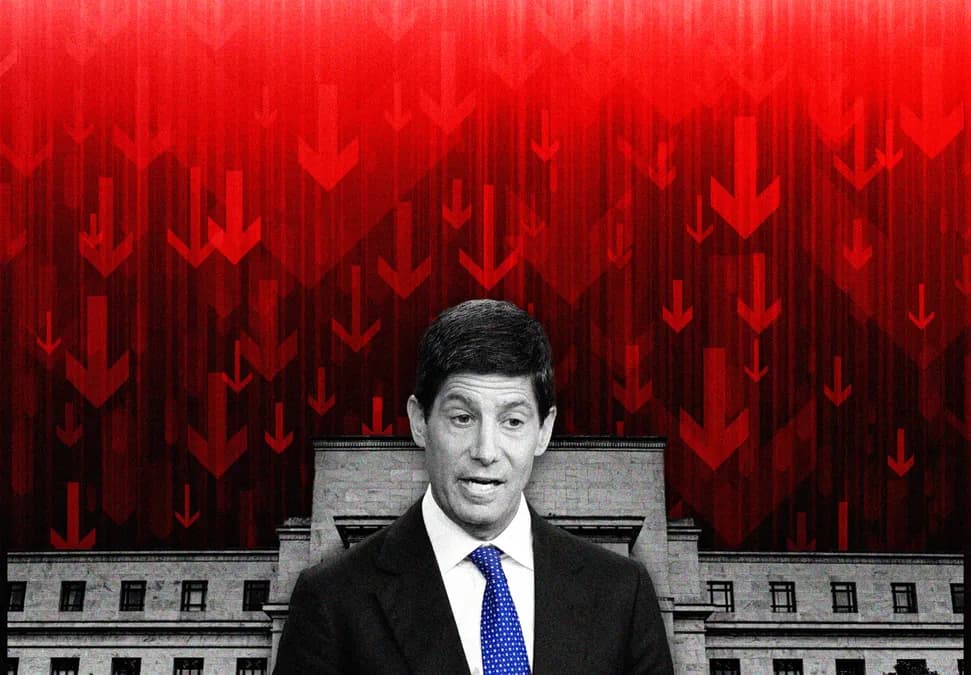
The Dow Jones Industrial Average shed 600 points following the Federal Reserve's latest rate decision — a sharp reminder that when central banks signal commitment to a prolonged tightening cycle, financial markets absorb the message painfully. Fed Chair Kevin Warsh has now delivered that signal with unmistakable clarity: the fight against inflation is not winding down. It is, by his reckoning, far from over.
Warsh's posture represents a deliberate break from the kind of pivot-anticipation that has animated Wall Street for the better part of two years. Investors who had grown accustomed to reading central bank communications for soft language and dovish exits found none of that in the Fed's most recent statement. Instead, Warsh offered something far less comfortable: resolve. The Fed, he made plain, will stay in the inflation fight for as long as necessary — even if that means absorbing significant turbulence in equity and bond markets along the way.
This is not merely rhetorical positioning. It is a policy posture with substantial historical precedent and real-world consequences for borrowers, businesses, and asset prices across every major class.
Why the Fed's Inflation Fight Has Longer to Run

Persistent inflation rarely surrenders to a single rate hike. That lesson was written in painful detail during the Volcker era of 1979 to 1981, when the Federal Reserve under Paul Volcker raised the federal funds rate to a peak above 20 percent before inflation — which had run above 13 percent annually — finally broke. The cost was severe: back-to-back recessions, double-digit unemployment, and a housing market that seized entirely. But the inflation dragon was slain, and the credibility the Fed built during that period anchored American monetary policy for decades.
Read next Altman: OpenAI IPO 'Ill-Advised' in 2026 | AI ValuationsMore recently, the 2022-2023 tightening cycle under Chair Jerome Powell demonstrated that even rapid, aggressive rate increases — 525 basis points across roughly 18 months, the fastest hiking pace in four decades — cannot guarantee a swift return to the 2 percent target. Core inflation proved stickier than models predicted, particularly in services and shelter components of the Consumer Price Index.
Warsh's current stance suggests the Fed has absorbed that lesson. Rather than declare victory prematurely or hint at near-term cuts, he is signaling a willingness to hold rates at restrictive levels long enough to ensure inflation expectations remain anchored. The risk of easing too early — of letting inflation re-accelerate and forcing a second, more disruptive tightening cycle — appears to weigh more heavily in his calculus than the risk of overtightening.
Bond market pricing tends to be the most honest gauge of how credible this commitment is. When the Fed says rates will stay higher for longer and the market actually believes it, the Treasury curve adjusts accordingly. The question now is whether Warsh can maintain that credibility as economic data inevitably grows more mixed and political pressure to ease mounts.
Market Reaction to the Fed's Hawkish Stance

The Dow's 600-point decline following the Fed decision was not an anomaly. It was a rational repricing event. Equity valuations, which had been built partly on expectations of a return to lower borrowing costs, must now be reassessed against a backdrop of rates staying elevated for an extended period. Higher rates raise the discount rate applied to future corporate earnings, compressing price-to-earnings multiples across the board.
The bond market told a parallel story. Treasury yields moved sharply, reflecting investor recalibration of where the terminal rate now sits and how long it will stay there. Credit spreads — the premium investors demand to hold corporate debt over risk-free Treasuries — widened as the market priced in a higher probability of economic stress filtering through to corporate balance sheets.
Volatility, as several bond market strategists had anticipated, is now the default condition rather than the exception. Sharp swings in both equities and fixed income are the natural consequence of a policy environment where the Fed's next move is no longer assumed to be a cut. When central bank optionality is constrained by an inflation mandate being taken seriously, markets must continually reprice uncertainty. That process is rarely orderly.
For retail investors, the message is direct: the period of near-zero rates that allowed virtually every risk asset to outperform has ended, and Warsh's actions confirm there is no imminent return to that era.
Kevin Warsh's Policy Philosophy and Track Record
Understanding Warsh's approach to monetary policy requires stepping back from the immediate rate decision and examining the intellectual framework he brings to the role of Fed Chair. A former Federal Reserve governor who served from 2006 to 2011, Warsh observed at close range both the pre-crisis period of policy complacency and the emergency interventions that followed the 2008 financial collapse. That experience shaped a hawkish institutional instinct — one suspicious of the idea that central banks can fine-tune economic outcomes without creating distortions.
Warsh has been a consistent critic of extended periods of ultra-accommodative policy. He has argued that prolonged low rates misallocate capital, inflate asset prices beyond fundamentals, and ultimately create the conditions for precisely the inflationary disruptions the Fed is now trying to contain. From that vantage point, the current tightening cycle is not a corrective measure so much as a reckoning for years of insufficient restraint.
His communication style reflects this philosophy. Where some Fed chairs have favored studied ambiguity — leaving markets to interpret forward guidance through multiple possible lenses — Warsh appears more inclined toward directness. The message embedded in the latest rate action was not subtle: when it comes to the Fed's price stability mandate, he intends to be taken at his word.
What Comes Next: Rate Path and Economic Implications
The dot-plot projections that accompany Fed decisions offer a structured window into how policymakers collectively view the rate path. If Warsh's public posture reflects the median view among FOMC members, investors should expect fewer near-term cuts than the market had previously priced. The gap between market expectations and Fed projections — when it opens meaningfully — has historically been a source of significant volatility, and that gap now appears to be widening in favor of the Fed's more hawkish trajectory.
On the real economy side, the implications of sustained restrictive rates compound over time. Mortgage rates at elevated levels suppress housing affordability and new construction. Corporate borrowing costs rise, restraining capital investment. Small businesses, which depend heavily on credit, face margin pressure. Consumer spending — the engine of roughly 70 percent of U.S. GDP — may slow as credit card rates and auto loan rates remain high.
Whether this path tips into recession remains, as macroeconomic analysts widely note, dependent on the sequencing of data. A labor market that holds up longer than expected gives the Fed more runway. One that deteriorates quickly forces a choice between fighting inflation and preventing a hard landing — the same dilemma that has defined tightening cycles throughout modern monetary history.
What Investors Should Watch in the Months Ahead
Several indicators will determine whether Warsh's hawkish stance results in a controlled deceleration or a sharper contraction. Monthly CPI and PCE releases will carry outsized market significance. Any upside surprise to core inflation — particularly in services components that have proven resistant to rate hikes — will reinforce the case for additional tightening and extend the duration of the current restrictive environment.
Treasury yield movements, especially at the two-year end of the curve most sensitive to Fed policy expectations, deserve close attention. A sustained rise in the two-year yield signals that the market is pricing more tightening; any reversal would suggest the bond market is losing confidence in the Fed's stated path.
Equity markets will remain sensitive to earnings guidance. Companies will need to demonstrate that their margins can absorb higher financing costs and softer consumer demand simultaneously. Those that cannot will reprice sharply.
Finally, Fed communications — speeches, press conferences, and the minutes from FOMC meetings — will be parsed with unusual intensity. Warsh has drawn a line. Whether that line holds, shifts, or gets tested by unexpected data is the central question defining the investment landscape for the months ahead. For now, one thing is clear: the inflation fight has more chapters left to write.
Source: MarketWatch.com - Top Stories