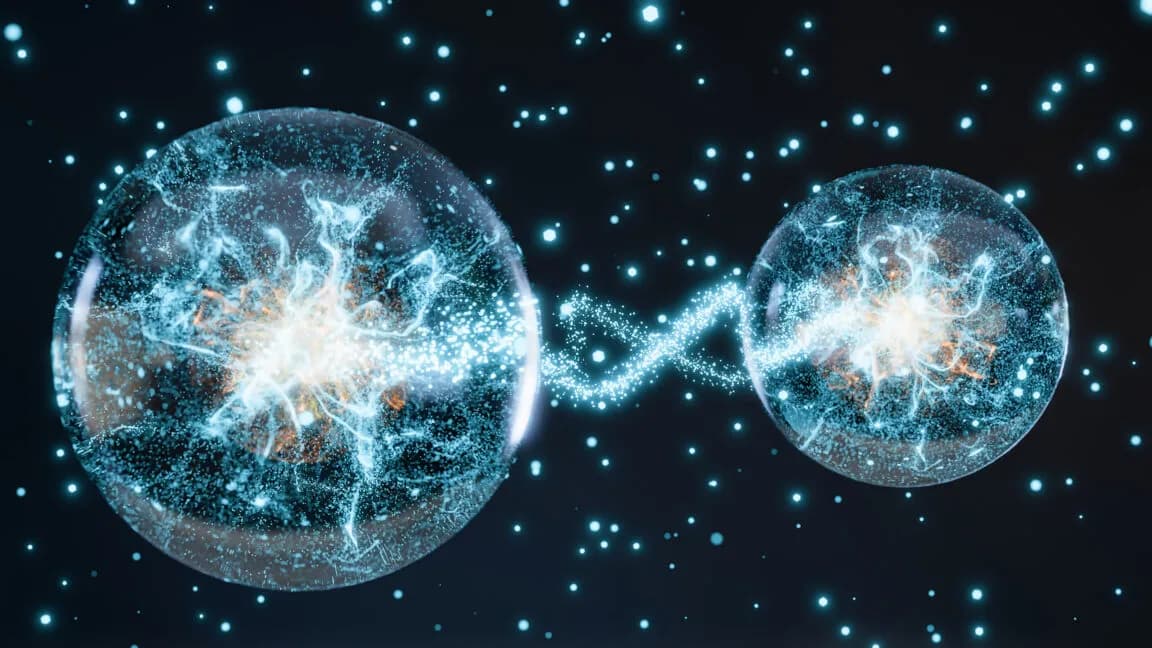
The Century-Old Conflict Between Quantum Mechanics and Relativity
For roughly a century, two of the most successful theories in the history of science have refused to get along. Quantum mechanics, developed through the 1920s and refined over subsequent decades, governs the behavior of particles at subatomic scales with staggering precision — its predictions match experiments to more than ten decimal places. Einstein's general theory of relativity, published in 1915, describes gravity not as a force but as the curvature of spacetime caused by mass, and it has passed every observational test thrown at it, from the bending of starlight to the detection of gravitational waves.
Yet when physicists attempt to apply both frameworks to the same problem simultaneously — to describe a quantum particle under the influence of gravity — the mathematics breaks down. The two theories speak different languages. General relativity is a classical theory, rooted in smooth, continuous geometry. Quantum mechanics is fundamentally probabilistic, built on superposition, uncertainty, and wave functions. The reconciliation of quantum mechanics and relativity remains the most consequential unsolved problem in theoretical physics.
Now, for the first time, an experimental team has directly probed the seam between them. The result, led by Ron Folman, a physicist at Ben-Gurion University of the Negev, and involving collaborators across Germany, the United Kingdom, and the United States — including Nobel laureate Roger Penrose — may mark the beginning of a new empirical era in the search for a unified theory of quantum gravity.
The Theoretical Prediction: What Free Fall Does to a Quantum Wave
Since Galileo rolled balls down inclined planes in the sixteenth century, physicists have had reliable tools for describing falling objects — their position, velocity, and acceleration under gravity. The picture seemed complete. Then quantum mechanics arrived and complicated everything.
Read next Laika's Wildwood: Stop-Motion Fantasy at TIFF 2026The central insight of quantum mechanics is that matter is not merely particle-like; it is also wave-like. This is not metaphor. Every physical object — an electron, a buckminsterfullerene molecule, in principle even a grain of sand — has an associated quantum wave that describes the probability distribution of its properties. "Every particle, doesn't matter if it's a car or a spaceship or an atom, is a wave," Folman has explained. "Everything that is a wave, like sea…" — the analogy extends to interference, diffraction, and superposition.
Nearly a century ago, theorists worked out what gravity should do to that wave. The prediction concerns a specific wave-like property of a quantum particle undergoing free fall. According to the theoretical framework developed in the early days of quantum mechanics, free fall should affect the quantum wave in a particular, calculable way — imprinting a signature on the particle's phase, the precise timing of its oscillation.
This prediction matters enormously. If gravity behaves toward quantum waves exactly as the old theory says, then a path toward reconciling quantum mechanics with Einstein's gravity remains open. If the prediction is wrong — if the measured effect deviates from what the theory demands — then quantum mechanics and general relativity do not merely disagree philosophically; they flatly contradict each other at an empirical level. That would mean neither theory, in its current form, is complete. The stakes could not be higher.
Building the Breakthrough: The New Atom Interferometer
The difficulty was not conceptual. Physicists have known for decades what measurement to make. The barrier was purely instrumental: no one had built a device capable of making it.
Atom interferometers work by exploiting the wave-like nature of atoms. When a single atom is split into two quantum pathways — a superposition of being in two places at once — the two branches of its wave function can later be recombined. Because waves interfere, the final state of the atom carries information about what happened along each path. The technique is already used in precision gravity measurements and tests of fundamental constants.
But the specific measurement required here demanded something no existing interferometer could achieve: one path where an atom undergoes genuine free fall under gravity, and another path where the same atom is held completely stationary, both paths ending at exactly the same location at exactly the same moment. The experimental precision required to achieve this — to hold one atom suspended in space while its quantum twin falls freely, and then reunite them coherently — defeated every prior attempt.
Folman's team built an instrument that finally clears that bar. The new interferometer gives a single atom two simultaneous possible trajectories: one path involves free fall, descending under gravity without electromagnetic support; the other path holds the atom perfectly still. The paths are not metaphorical alternatives but genuine quantum superpositions — the atom is, in a real physical sense, both falling and stationary at once. Both trajectories converge on the same spatial point at the same moment, and the interferometer measures the quantum interference between them with sufficient fidelity to detect the gravitational phase shift the old theory predicts.
This is the instrument that did not exist before. Its construction required coordinating expertise across multiple countries and disciplines — the international collaboration spanning Ben-Gurion University, German institutions, UK research groups, and US partners reflects both the technical depth required and the significance the broader physics community has attached to this measurement.
What the Results Mean for Physics
The interferometer has now performed the measurement that has been theoretically available but experimentally unreachable for nearly a hundred years. The result directly tests whether the nearly century-old prediction about free fall and quantum wave behavior holds.
The significance depends on what was found. If the measured phase shift matches the theoretical prediction, that constitutes an important verification: the mathematical framework describing how gravity interacts with quantum waves is at least consistent at the scales this experiment probes. That would not, by itself, resolve the quantum-gravity unification problem — but it would confirm that the semiclassical approximation physicists have long used is empirically sound in this regime, providing a firmer foundation for future theoretical work.
If the result deviates from the prediction, the implications are more radical. Any significant discrepancy would signal that quantum mechanics and general relativity are in genuine empirical conflict — not merely philosophically incompatible but observationally contradictory. That would be a sharp experimental prod forcing the physics community to abandon or substantially revise at least one of the two frameworks. The presence of Roger Penrose among the collaborators is telling. Penrose has long argued that the unification of quantum mechanics and gravity will require conceptual revisions at the deepest level, including potentially modifying the quantum measurement postulate itself.
Either outcome advances the field. Confirmation narrows the space of viable quantum-gravity theories. A discrepancy opens it dramatically, pointing toward new physics.
The Road Ahead: Reconciling Quantum Mechanics and Einstein's Gravity
A single experiment does not resolve a century-old theoretical impasse. But experiments like this one set the empirical boundary conditions within which any successful unified theory must operate.
The construction of Folman's interferometer opens an experimental program that could not begin before. Future iterations of the device can probe different regimes of the gravitational phase effect — varying the duration of free fall, the atomic species used, or the interferometer geometry — building a systematic empirical map of where the standard prediction holds and, crucially, whether it ever breaks down. Each data point tightens the constraints on quantum gravity candidates, from loop quantum gravity to string-theoretic approaches to Penrose's own gravitational decoherence hypothesis.
The more fundamental challenge remains. Quantum mechanics and Einstein's gravity are not merely technically difficult to combine; they seem to require incompatible pictures of reality. General relativity treats spacetime as a smooth, deterministic backdrop. Quantum mechanics treats physical states as inherently probabilistic superpositions until measurement collapses them. How spacetime itself can be quantized — if it can be — is a question that has consumed generations of brilliant physicists without a consensus resolution.
What this experiment provides is something invaluable: ground truth. For nearly a hundred years, the intersection of quantum mechanics and relativity has been primarily a theoretical battlefield, with competing mathematical frameworks dueling in the absence of direct empirical input. The interferometer built by Folman and his international colleagues changes that. The question of what gravity does to a quantum wave is no longer unanswerable. It now has a measured response.
Physics advances through exactly this kind of moment — when a technically forbidding measurement finally becomes achievable and the universe is asked directly what it does. Whatever the result shows, the era of testing quantum gravity at the laboratory bench has begun.
Related coverage
- Trump's AI Medicare Experiment Is Denying Senior Care
- RSA Broken Without Quantum Computer: New 2026 Attack
Source: Ars Technica - All content