September 2026 Science Roundup: Six Stories You May Have Missed
There is always more science than there is time to cover it. Particle physicists, archaeologists, and historians of science each publish dozens of significant findings every month, most of which never reach a general audience. These science stories 2026 has produced deserve wider attention — from a detector buried in a South Dakota gold mine whispering hints of dark matter, to the Large Hadron Collider achieving something quantum mechanics once made seem theoretical, to archaeological evidence suggesting humans were using mind-altering substances far earlier than previously documented.
September delivered an unusually rich cluster of overlooked research. What follows is a guided tour through six of the most compelling findings that nearly slipped past the news cycle.
A Tantalizing Hint of Dark Matter at LUX-ZEPLIN

Physicists estimate that roughly 85 percent of all matter in the universe is dark matter — a form of matter that neither emits nor absorbs light, making it effectively invisible to conventional telescopes. Despite that overwhelming abundance, no experiment has ever produced a confirmed direct detection. The universe's dominant ingredient remains, embarrassingly, unknown.
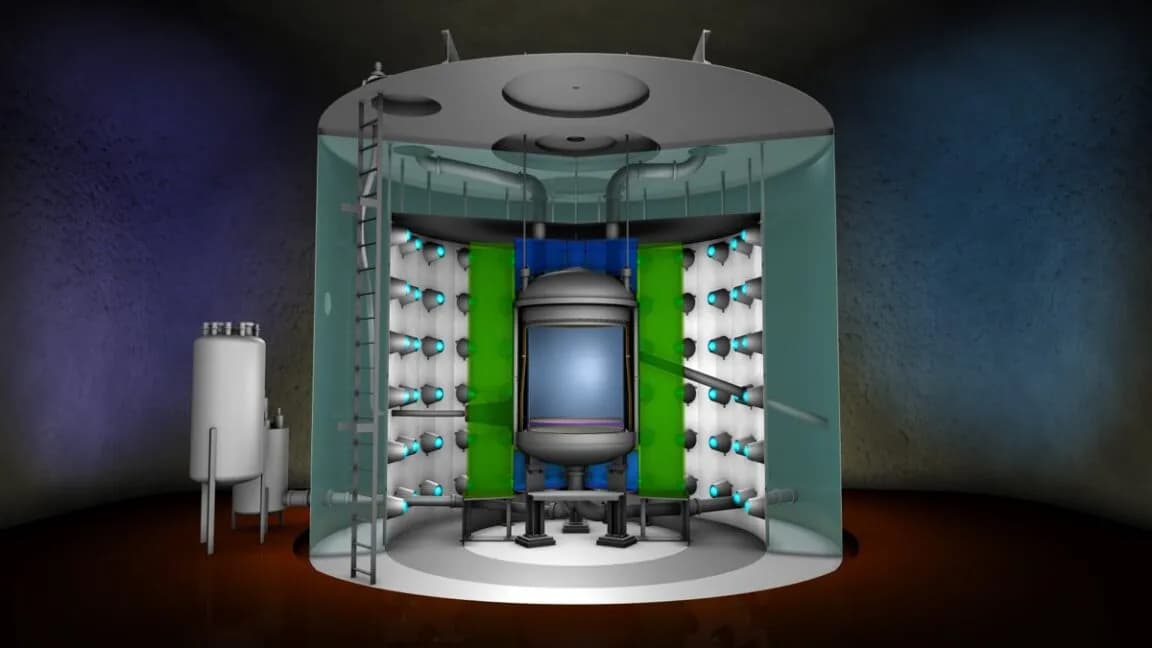
Read next Laika's Wildwood: Stop-Motion Fantasy at TIFF 2026That may be starting to change. Results presented at the 2026 TeV Particle Astrophysics conference in Nagoya, Japan, offered what researchers are carefully calling a hint — not a discovery, but a signal worth watching. The data came from the LUX-ZEPLIN detector, a 10-tonne liquid xenon instrument housed roughly 1.5 kilometers underground in the Sanford Underground Research Facility, carved from a former gold mine in the Black Hills of South Dakota. The depth is essential: the overlying rock shields the detector from cosmic rays that would otherwise drown any faint signal.
The leading candidate for dark matter remains the WIMP — a weakly interacting massive particle. WIMPs interact with ordinary matter only through gravity and the weak nuclear force, meaning any collision with a xenon nucleus would be extraordinarily rare. LUX-ZEPLIN is designed to catch precisely those rare collisions, recording the tiny flashes of light they produce.
The preprint describing the potential signal has been posted to arXiv and submitted to Physical Review Letters, one of physics' most rigorous peer-reviewed journals. Physicists are measuring their language deliberately. Words like "hint" and "excess" dominate the discussion, not "detection." Extraordinary claims require extraordinary evidence, and the collaboration has not yet crossed the statistical threshold — typically five standard deviations — that physics conventionally requires to announce a discovery. Still, after decades of null results from earlier experiments, any non-zero signal at LUX-ZEPLIN merits serious attention.
Entangled Z Bosons Detected at the Large Hadron Collider

Quantum entanglement — the phenomenon Einstein famously dismissed as "spooky action at a distance" — has been demonstrated in photons, electrons, and atoms. But the Large Hadron Collider at CERN has now pushed entanglement into a regime that would have been difficult to imagine even a decade ago: the Z boson.
Z bosons are among the heaviest fundamental particles, roughly 91 times the mass of a proton. They exist for an almost incomprehensibly brief moment — on the order of 10⁻²⁵ seconds — before decaying. The new result shows that pairs of Z bosons produced in proton-proton collisions at the LHC can be entangled at the moment of their creation, with the entanglement measurable through the angular distributions of their decay products.
This is not merely a curiosity. Testing quantum entanglement at the energy scales accessible only to particle colliders probes whether the fundamental rules of quantum mechanics hold in unexplored territory. Any deviation — however small — would signal physics beyond the Standard Model.
Psychoactive Substances in the Late Pleistocene
The archaeological record is full of surprises about when humans first did things we consider distinctly modern. New research adds an entry to that list: the possible intentional use of psychoactive substances during the Late Pleistocene, a period stretching roughly from 126,000 to 11,700 years ago.
The evidence, drawn from excavated sites and analysis of plant residues, suggests that some prehistoric human communities may have had knowledge of — and perhaps ritual use for — plants with mind-altering properties. The claim rests on contextual evidence rather than a single smoking gun, and the researchers frame it appropriately as "possible" use rather than established fact.
What makes this significant is the timeline. If confirmed, it would push the known history of intentional psychoactive substance use substantially earlier than previous estimates, raising questions about the cognitive and social lives of late Pleistocene humans. Did altered states play a role in early ritual behavior? Did shared experiences around psychoactive plants contribute to social bonding in small hunter-gatherer groups? The research does not answer those questions, but it sharpens them considerably.
Rediscovering Galileo: A Technical Look at His Telescope
Among this month's most quietly fascinating findings is a new technical analysis of a telescope attributed to Galileo Galilei. Galileo did not invent the telescope — Dutch lens-makers produced the first working instruments around 1608 — but his refinements and his willingness to point the device at the night sky transformed astronomy.
The new analysis engages with primary source material: Galileo's own written technical descriptions of his instrument. Researchers examined the optical specifications he documented and compared them against surviving physical specimens and contemporary accounts. The goal was not to produce a sensation, but to reconstruct with precision what Galileo's telescope could actually resolve — what angular resolution it achieved, what magnification it offered, and what limitations it imposed on his observations.
This kind of detailed technical archaeology matters for the history of science. It situates Galileo's discoveries — the moons of Jupiter, the phases of Venus, the mountains of the Moon — within the real constraints of the instrument he used. It also raises the possibility that some ambiguities in early telescopic astronomy can be revisited with a clearer understanding of what early 17th-century instruments could and could not show.
Why These Overlooked Science Stories Matter
The stories above share a quality that distinguishes the best science journalism from the merely competent: they resist premature certainty. The LUX-ZEPLIN results are a hint, not a headline. The Pleistocene psychoactive evidence is possible, not proven. The Galileo analysis is a careful reconstruction, not a dramatic revision.
That epistemic humility is, itself, the story. Science advances through the accumulation of careful, provisional findings — most of which never receive public attention. A WIMP detection signal that does not survive peer review is still valuable: it sharpens the detector's calibration and narrows the parameter space where dark matter might hide. An archaeological finding that raises questions about Pleistocene cognition without fully answering them still enriches our understanding of human prehistory.
The LHC's entangled Z bosons are perhaps the cleanest example of a result whose significance is easy to understate. No immediate application follows from it. No technology changes overnight. But confirming that quantum entanglement operates at the highest energies currently accessible to experiment is a test of the foundations of physics — the kind of foundational work that has, repeatedly throughout history, preceded practical transformation.
Monthly science roundups exist precisely because the scientific literature moves faster than any publication can track. In September 2026, particle astrophysicists, quantum physicists, archaeologists, and historians of science each produced work worth knowing about. These six items are the ones that came closest to slipping away unnoticed.
Source: Ars Technica - All content