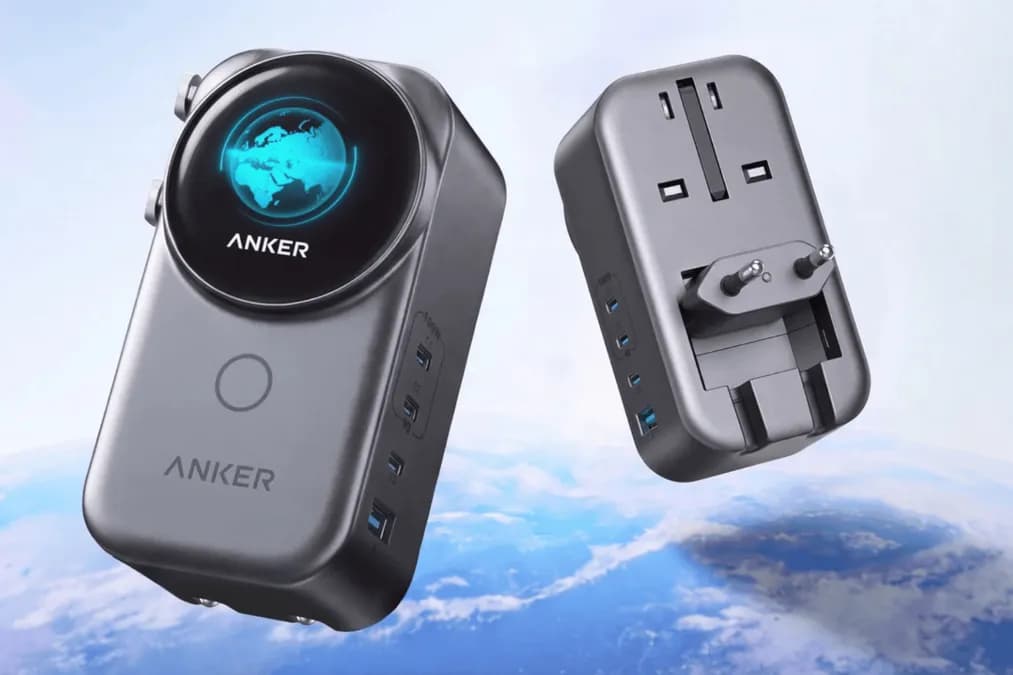
Carry-on packing is an exercise in brutal math. Every ounce and cubic inch you reclaim from luggage is a small victory, which is why experienced road warriors tend to obsess over chargers the way cyclists obsess over bike weight. The Anker Nano 100W travel charger has been circulating in frequent-flyer circles as one of the more thoughtfully designed universal adapters on the market — and an October Prime Day discount to $63.99 makes it worth a hard look.
What Is the Anker Nano 100W Universal Travel Charger?
The Anker Nano 100W travel charger is a compact universal adapter that consolidates multiple USB charging ports into a single device while also handling the physical plug-compatibility problem that plagues international travel. It ships with interchangeable US, UK, and EU plugs, enabling it to work with electrical outlets in more than 200 countries and regions.
That 200-country figure sounds like marketing, but the underlying electrical engineering reality makes it meaningful. The International Electrotechnical Commission (IEC) recognizes at least 15 distinct plug and socket formats currently in widespread use worldwide — Types A, B, C, D, E, F, G, H, I, J, K, L, M, N, and O — and individual countries can further vary by voltage (100V–240V) and frequency (50Hz or 60Hz). Covering 200 countries through three interchangeable plugs means the adapter's internal circuitry must auto-sense input voltage and regulate accordingly, protecting your devices from frying when you switch from a 120V US hotel room to a 230V European one.
The 100W output figure speaks directly to USB Power Delivery (USB-PD) standards, the open protocol that governs fast charging across laptops, tablets, and smartphones. Under USB-PD 3.0, a single port can negotiate up to 100W, enough to charge a 16-inch MacBook Pro or a Dell XPS 15 at near-full speed. When you're splitting that 100W across multiple ports simultaneously, the adapter negotiates lower wattages per port — a standard and expected behavior under PD protocols.
Why This Charger Stands Out for Frequent Travelers
Airport layovers have a way of exposing the limits of bad gear. If you've ever competed with three strangers for a single outlet near a departure gate, you understand why multi-port adapters are worth more than their sticker price suggests.
Read next Laika's Wildwood: Stop-Motion Fantasy at TIFF 2026The Anker Nano 100W travel charger addresses several pain points at once. A single device handles outlet compatibility and multi-device charging, eliminating the need to pack a separate country-specific adapter alongside a charging brick. For travelers who routinely carry a laptop, tablet, phone, and wireless earbuds, that consolidation matters. A 2023 survey by the Global Business Travel Association found that business travelers carry an average of 3.3 personal electronic devices on trips — and that number has trended upward as remote-work flexibility means more people blending travel with productivity.
Hotel rooms, particularly outside major business hotel chains, often offer only one or two accessible outlets per room, sometimes in inconvenient locations. A multi-port adapter with universal plug compatibility turns one awkward outlet into a full charging station. Frequent travelers in communities like FlyerTalk and Reddit's r/solotravel regularly cite compact universal chargers as among the most-recommended pieces of carry-on gear, often prioritized above premium luggage accessories.
The "Nano" branding in the Anker Nano 100W travel charger line references the company's use of gallium nitride (GaN) transistor technology, which generates less heat and allows for more compact form factors than traditional silicon-based chargers at equivalent wattages. A 100W silicon adapter from five years ago was a brick. GaN components allow modern chargers to shrink considerably while maintaining output.
October Prime Day Pricing: Is $64 a Good Deal?
Amazon's October Prime Day sale prices the Anker Nano 100W travel charger at $63.99, down from a standard retail price of $79.99. That represents a 20% discount — not the dramatic 40–50% cuts that drive Prime Day headlines, but a meaningful reduction on a product that rarely drops.
Context matters here. Universal travel adapters in the 90–100W USB-PD range from reputable brands generally retail between $60 and $100. Budget alternatives exist in the $25–$35 range, but those products frequently compromise on safety certifications, surge protection quality, and the precision of their voltage auto-sensing circuits. A substandard adapter can fail gradually, delivering inconsistent wattage, or catastrophically, through electrical damage to connected devices.
For a product you'll use across multiple trips and rely on to protect expensive electronics, the $64 price point sits in a reasonable value zone. If you've been on the fence about consolidating your travel charging kit, a sale is a logical time to commit.
Who Should Buy This Travel Adapter?
The Anker Nano 100W travel charger is best suited for a specific traveler profile: someone who travels internationally at least a few times per year, carries multiple USB-C devices, and prioritizes packing light.
Business travelers crossing between North America, Europe, and the UK will extract the most immediate value, since those three plug formats cover the widest swath of their itineraries. Digital nomads working from co-living spaces or Airbnb rentals — where outlet availability and safety can be unpredictable — will similarly benefit from an adapter with reliable surge protection.
Casual vacationers who travel domestically or to a single country once per year may find less value here. A destination-specific adapter or a simpler charging brick might suit their needs at a lower cost.
One scenario where this product earns its keep immediately: the overnight layover. When you're spending nine hours in Heathrow or Changi with a dying laptop and a single outlet under your seat, an adapter that handles UK plugs and delivers full USB-PD output to your MacBook isn't a luxury.
How It Compares to Other Universal Travel Chargers
The universal travel adapter market has become competitive. Belkin, Satechi, RavPower, and several other brands offer comparable products, each with tradeoffs.
Belkin's universal adapters tend to carry strong brand recognition and retail distribution, but their 100W options typically price higher than the Anker Nano 100W travel charger. Satechi products are popular among Apple-ecosystem users and offer clean industrial design, but again at a price premium. Generic adapters on Amazon from lesser-known brands frequently undercut on price — sometimes significantly — but independent electrical safety testing from organizations like UL (Underwriters Laboratories) and CE certification bodies have found inconsistencies in budget-tier adapters' voltage regulation and overcurrent protection.
Anker's position is middle-market: better quality control than no-name alternatives, more competitive pricing than premium lifestyle brands. The company has built a substantial reputation in the USB charging accessory space over the past decade, and its PowerIQ and related charging intelligence systems have been independently tested by tech publications including The Verge and Wirecutter, generally confirming rated outputs under real load conditions.
Final Verdict: Worth Adding to Your Travel Kit?
If your current travel setup involves juggling multiple adapters, wrestling with country-specific plugs, or hunting for enough outlets to charge a laptop and a phone simultaneously, the Anker Nano 100W travel charger solves those problems in a single device.
At $64 during October Prime Day, it's a practical purchase rather than an impulse buy. The 20% discount from the standard $79.99 price isn't dramatic, but the value proposition holds even at full price for frequent international travelers. The combination of 200-country outlet compatibility, 100W USB-PD output, and Anker's track record for build quality puts this adapter in a short list of products that genuinely earn their place in a carry-on.
Buy it if you travel internationally more than twice a year and carry USB-C devices that benefit from fast charging. Hold off if your travel is mostly domestic or you only need to charge a single smartphone.
Related coverage
Source: The Verge