The Arctic in Crisis: Understanding the World's Fastest-Warming Region
Since 1971, the Arctic has warmed three to four times faster than the global average, a rate documented by the NOAA Arctic Report Card. This disproportionate heating pattern is fundamentally altering the cryosphere, threatening global climate stability. Sea ice records provide stark evidence: NASA NSIDC satellite data shows the annual minimum sea ice extent has declined dramatically since 1979, hitting a notably low 3.41 million km² in 2012. These accelerating changes mean the region is warming far beyond historical norms.
How Fast Is the Arctic Actually Warming?
The warming trajectory is not uniform; it is characterized by rapid shifts in temperature and permafrost integrity. Studies published in Nature Climate Change confirm that the rate of warming exceeds global models that account only for atmospheric CO2 increases. This accelerated warming poses significant risks to terrestrial ecosystems, destabilizing methane hydrates trapped beneath the seabed. Scientists warn that the combination of warming temperatures and rising atmospheric CO2 concentration makes the region highly susceptible to irreversible tipping points, a concern emphasized in the IPCC AR6 Working Group I findings. The speed of this warming means that many natural feedback loops are already engaged.
Arctic Amplification Explained
The primary physical mechanism driving this rapid change is Arctic Amplification. This process describes the positive feedback loop where initial warming reduces reflective surfaces, leading to further, accelerated warming. When bright, reflective sea ice melts, it exposes darker ocean water. This dark water absorbs significantly more solar energy—a process known as reduced albedo. This energy absorption warms the water and the overlying atmosphere, which, in turn, melts more ice. The resulting instability illustrates why understanding the complex mechanics of Arctic climate change is critical for global mitigation strategies. The current rate of loss demands immediate global action.
Arctic Sea Ice: Decline, Records, and Consequences
Read next How Climate Change Works: A Clear ExplainerSummer Sea Ice Minimum Trends Since 1979
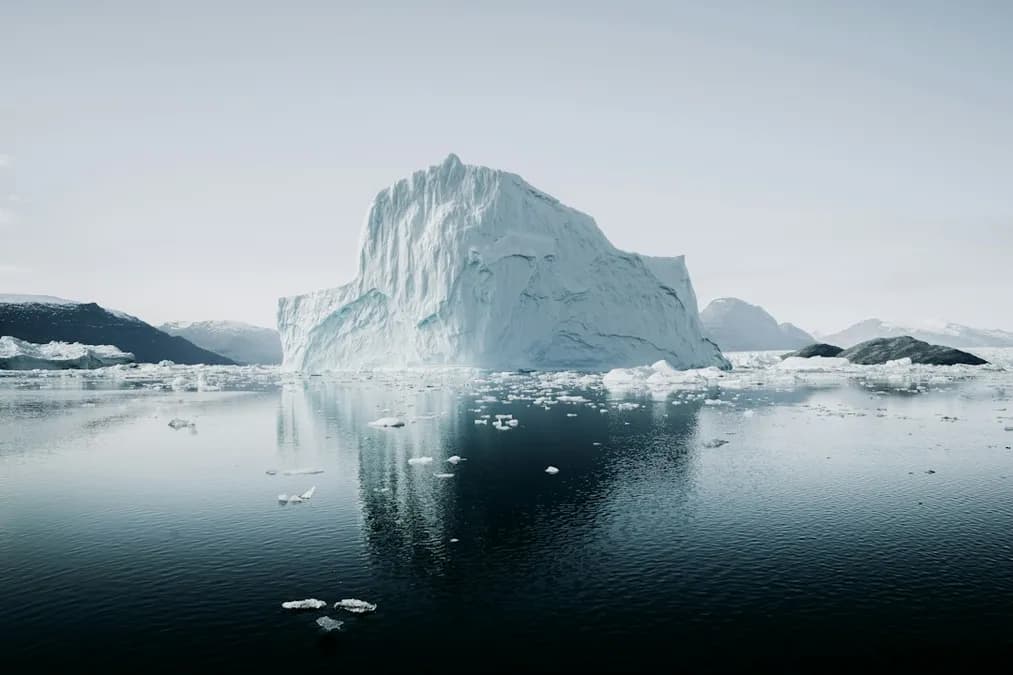
The 2012 minimum sea ice extent, recorded by NASA’s National Snow and Ice Data Center (NSIDC) at 3.41 million square kilometers, marked a significant trough in decades of observation. This trend of diminishing ice cover reflects a fundamental shift in the cryosphere. Since 1979, satellite records have consistently documented a dramatic reduction in the annual minimum extent of Arctic sea ice. The rate of loss is accelerating, creating a positive feedback loop that influences regional warming. Data from NOAA's Arctic Report Card confirms that the region has warmed three to four times faster than the global average since 1971.
This rapid warming is not merely a temperature anomaly; it fundamentally alters the planet’s albedo. When bright, reflective ice melts, it exposes darker ocean water, which absorbs significantly more solar radiation, thus accelerating further warming. Leading climate assessments, such as the IPCC AR6 Working Group I findings, emphasize the concept of cryosphere tipping points, suggesting that continued ice loss could trigger irreversible shifts in global climate systems.
The implications of this decline extend far beyond the polar regions. The destabilization of permafrost, which stores vast amounts of methane, represents a critical concern. Research published in Nature Climate Change details how these methane releases complicate projections for future warming. Continued loss of this seasonal ice blanket intensifies the mechanisms of Arctic climate change, impacting global weather patterns and ocean circulation. Understanding the scale of this decline is essential for modeling future sea-level rise and predicting shifts in marine biodiversity. The speed of this change demands immediate scientific focus.
Permafrost Thaw and the Carbon Feedback Loop
At rates exceeding three times the global average since 1971, the Arctic is warming rapidly, destabilizing millennia of frozen carbon stores. This deep carbon reservoir, locked within permafrost—ground that has remained frozen for at least two years—represents a planetary tipping point. When this ice thaws, microbes access vast quantities of organic matter, initiating a powerful feedback loop that accelerates global warming.
Methane Release and Global Warming Potential
The primary concern centers on the release of potent greenhouse gases, particularly methane ($\text{CH}4$) and carbon dioxide ($\text{CO}2$). While $\text{CO}2$ dominates the overall volume of carbon released, methane is far more potent in the short term. Over a 20-year period, methane’s global warming potential is roughly 80 to 86 times greater than $\text{CO}2$. This makes the initial pulses of gas release highly impactful.
NASA's NSIDC satellite records show a stark decline in sea ice extent, with the 2012 minimum reaching just 3.41 million $\text{km}^2$. This melt not only reduces reflective surface area, exacerbating warming, but also exposes terrestrial permafrost. Research published in Nature Climate Change models suggest that thawing peatlands can transition from stable carbon sinks to active sources.
The Intergovernmental Panel on Climate Change (IPCC AR6 Working Group I) has repeatedly highlighted the cryosphere’s vulnerability, noting that thaw rates accelerate methane release through anaerobic decomposition. As Arctic climate change progresses, the gas can bubble out of thermokarst lakes or be released into the atmosphere by degrading methane hydrates. This positive feedback mechanism means that human emissions alone may not account for the full trajectory of warming; the planet itself is beginning to contribute significantly to the warming cycle. Understanding this natural forcing is critical for accurately modeling future warming scenarios.
Impacts on Arctic Wildlife and Indigenous Communities
The 2012 record low of 3.41 million km² for minimum September sea ice extent, tracked by NASA NSIDC satellite records, illustrates the drastic environmental shifts already underway. This rapid warming—documented by NOAA's Arctic Report Card showing the region heating three to four times faster than the global average since 1971—disrupts fundamental ecological cycles. Polar bears, for instance, depend on stable sea ice platforms for hunting seals, and reduced ice forces them into longer, energy-intensive swims or onto diminishing land reserves. Similarly, the loss of predictable ice habitat severely impacts narwhal and ringed seals, which rely on stable multi-year ice for birthing and resting.
For human populations, the consequences are immediate and profound. Coastal erosion, accelerated by diminishing sea ice and warming ocean temperatures, threatens traditional settlements. In Alaska, for example, villages like Shishmaref face existential threats as permafrost thaw destabilizes infrastructure, forcing communities to plan costly and complex relocations. These communities possess deep, specialized knowledge of the environment, knowledge now challenged by rapid warming patterns.
The IPCC AR6 Working Group I highlights the increasing risk of cryosphere tipping points, stressing that these changes cascade through both biological and physical systems. Changes in ocean chemistry, driven by increased freshwater runoff and warming, also affect marine food webs, impacting commercial fish stocks and traditional subsistence harvests. Furthermore, disruptions to migratory routes, particularly for caribou, are documented in peer-reviewed journals like Nature Climate Change. These compounding pressures—from destabilized infrastructure to altered hunting grounds—underscore that the impacts of Arctic climate change are not merely environmental; they are fundamental threats to human culture and survival.
How Arctic Changes Drive Extreme Weather Globally
The Arctic has warmed three to four times faster than the global average since 1971, according to data compiled by the NOAA Arctic Report Card. This rapid regional warming weakens the temperature gradient between the pole and the mid-latitudes, a fundamental shift with global weather consequences. This phenomenon, known as Arctic Amplification, reduces the strength of the jet stream, allowing massive waves of energy to propagate southward and destabilizing established atmospheric patterns.
The primary mechanism involves the Polar Vortex, a semi-permanent area of low pressure and strong winds circulating deep within the Earth’s atmosphere. When the heat difference between the Arctic and temperate zones shrinks—a direct consequence of diminishing sea ice—the jet stream loses its sharp boundary. Instead of flowing swiftly and consistently, the jet stream becomes wavier, exhibiting large, slow-moving undulations.
NASA NSIDC satellite records document this physical shift, showing record sea ice minimums, such as the 3.41 million km² recorded in 2012. These ice losses are not merely indicators of warming; they represent a massive reduction in the thermal barrier that normally stabilizes the atmosphere. When the jet stream falters, these large waves can detach and propagate far south, leading to prolonged, stalled weather patterns.
This instability is the key to global extreme weather. Instead of passing through quickly, weather systems become "stuck." This can manifest as persistent heat domes, where temperatures remain unusually high for weeks, or deep cold outbreaks, such as the recent extended cold snap seen across parts of North America. IPCC AR6 Working Group I findings emphasize that the cryosphere's tipping points, driven by accelerated warming, significantly increase the probability and intensity of these disruptive events. Understanding this connection is vital, as continued changes in the Arctic climate change regime directly dictate the frequency and severity of global weather extremes.
Rising Sea Levels: The Arctic's Global Footprint
The minimum extent of Arctic sea ice has declined dramatically since 1979, a trend documented by NASA’s National Snow and Ice Data Center (NSIDC). This record-breaking decline is evident in data showing the 2012 minimum reached just 3.41 million km², significantly below historical averages. This rapid loss of frozen water directly impacts global ocean circulation and the rate of sea-level rise. While the melting of floating sea ice does not immediately raise global sea levels, the concurrent loss of massive terrestrial ice sheets—such as the Greenland Ice Sheet—poses a direct, measurable threat to coastal populations worldwide.
The scientific consensus, reflected in IPCC AR6 Working Group I reports, points to the cryosphere’s instability as a critical tipping point. The rate of Arctic warming has surpassed the global average by a factor of three to four since 1971, according to NOAA Arctic Report Card data. This extreme regional warming accelerates the melt cycles, destabilizing permafrost and contributing to massive runoff. These melt inputs, combined with thermal expansion of warming ocean water, drive the global rise.
The physical reality is that for every fraction of a meter of sea level rise, coastal infrastructure faces escalating risks. For instance, projections indicate that unprotected megacities like Miami or Shanghai could see critical areas inundated under high-emissions scenarios. The feedback loop created by Arctic climate change—where melting ice exposes darker ocean water, which absorbs more solar energy—further accelerates warming. Scientists publishing in journals like Nature Climate Change emphasize that the magnitude of this regional warming dictates the severity of the global consequence. Addressing the root causes of Arctic climate change requires immediate, deep global emissions cuts to stabilize the planet's most volatile system.
What Scientists and Climate Bodies Are Predicting
The Arctic is warming three to four times faster than the global average since 1971, according to NOAA Arctic Report Card data. This rapid thermal expansion drives predictions of significant, irreversible shifts across the cryosphere. NASA NSIDC satellite records document this decline vividly; the minimum sea ice extent recorded in 2012 reached 3.41 million km², a dramatic departure from historical averages. This trend suggests that the region is entering a period of accelerated change, fundamentally altering global weather systems.
The IPCC Sixth Assessment Report (AR6) Working Group I emphasizes the risk of multiple cryosphere tipping points. These are non-linear thresholds—for example, the potential rapid destabilization of permafrost or the collapse of major ice sheets like Greenland. Such events release massive quantities of stored carbon and methane, creating a positive feedback loop that accelerates warming beyond human mitigation efforts. Scientists studying the impact of Arctic climate change predict a cascading effect: less reflective ice means more solar energy is absorbed by darker ocean water, intensifying warming further.
Beyond ice melt, the research published in journals like Nature Climate Change details shifts in ocean currents. Changes in freshwater influx from melting glaciers are altering the Atlantic Meridional Overturning Circulation (AMOC), a critical system that regulates heat distribution into the North Atlantic. This slowing mechanism could trigger extreme weather events thousands of miles away, affecting rainfall patterns in the American Midwest and European agriculture. The physical evidence demands immediate attention. Understanding the precise trajectory of Arctic climate change is now central to global climate modeling, requiring international cooperation to constrain future warming pathways and mitigate the worst predicted impacts.
Related coverage