Two independent streams of evidence now point to the same conclusion: Apple is building native four-speaker surround sound support into the Apple TV 4K and HomePod ecosystem. What began as a single leak last month has grown into a corroborated case backed by beta code, new system symbols, and a leaker with a verifiable accuracy record — a combination that rarely ends without an announcement.
What the Four-HomePod Surround Sound Rumor Claims
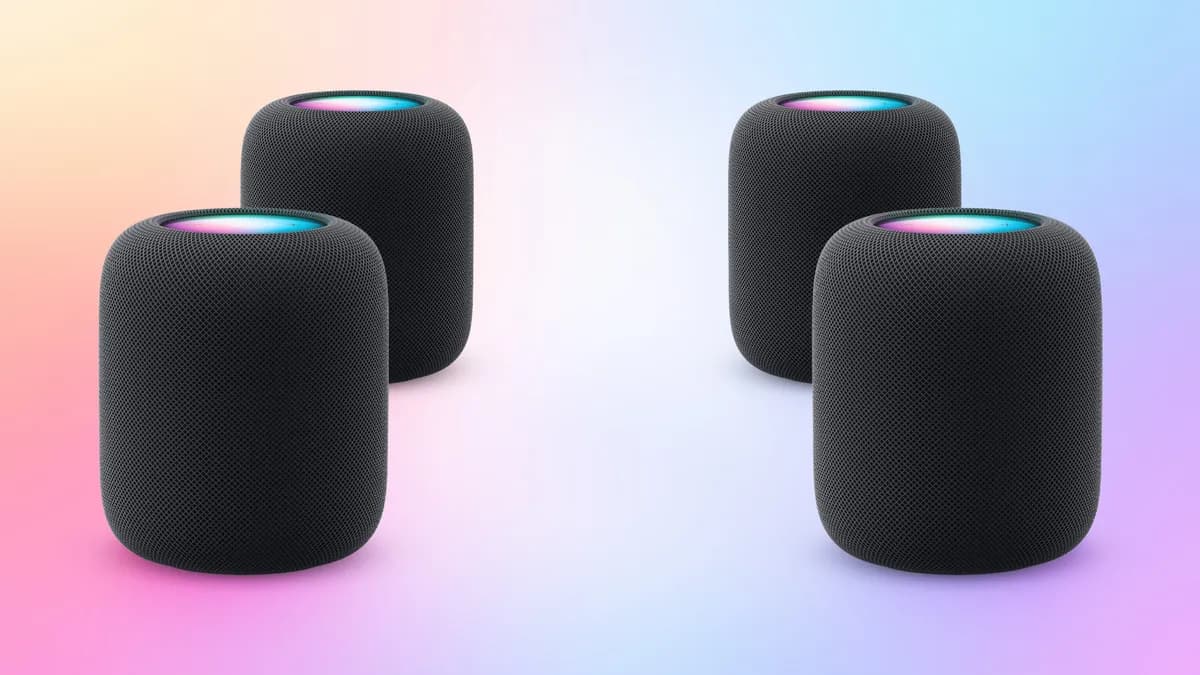
The core claim is specific. Apple has been testing the ability to pair four HomePods simultaneously with an Apple TV 4K, arranged in a classic quadraphonic layout: front-left, front-right, rear-left, and rear-right. That configuration mirrors the speaker placement used in traditional 5.1 and 7.1 home theater setups — minus a dedicated center channel — and maps directly onto the discrete channel assignments used in modern Dolby Atmos streams.
Today, Apple supports a two-speaker stereo pair through its HomePod pairing system, and a separate "home theater" mode that combines a stereo pair with an Apple TV 4K to deliver spatial audio. That setup is capable, but fundamentally limited. A two-speaker arrangement must synthesize phantom rear channels psychoacoustically — the audio processor guesses what the listener should hear behind them based on what's in front. Four discrete speakers eliminate that compromise entirely: actual sound can emanate from each corner of the room at the correct moment, anchoring footsteps, ambient noise, and musical cues to physical positions in space.
The leaker who initially reported this functionality, known online as "pdfu," has an established record of surfacing accurate Apple software details ahead of official disclosure. Leakers earn credibility through demonstrated hits, and pdfu's prior accurate disclosures about HomePod internals place this claim firmly in the "track down the beta code to verify" category rather than the speculative tier.
Beta Software Evidence Supporting the Rumor
Apple's internal HomePod operating system, called audioOS, shipped a third developer beta of version 27.2 in October 2026. Inside that build, pdfu identified new strings indicating that Siri can now be instructed to match a speaker to its surround system — a capability that requires the software to recognize speaker position, not just speaker identity. That distinction matters. Existing HomePod pairing treats speakers as a stereo unit; a positional matching feature implies each of the four speakers carries a role assignment the system actively manages.
Read next iPhone Duo's Hidden Fake Bezel Setting ExplainedThat finding alone would be notable. What makes the current evidence unusually strong is the second discovery, made independently by MacRumors contributor Aaron Perris inside the third beta of macOS 27.2. Perris found two new SF Symbols — the icon library Apple bundles into its operating systems for use by developers and system UI — depicting a group of four speakers arranged inside a room. SF Symbols are small, meticulously catalogued assets, and Apple does not add new ones casually. One of the newly identified symbols shows what appears to be a top-down room view with HomePods at each corner; the other explicitly describes the four-speaker arrangement as part of a home theater configuration.
Neither the audioOS strings nor the SF Symbols mention HomePod by name, which is consistent with how Apple phrases internal references to hardware that has not yet been announced. The language stays generic until launch day.
Why Two Independent Sources Make This Credible
Single-source leaks carry inherent uncertainty. A lone code string could be a dead branch, an abandoned experiment, or a deliberate red herring. Two independent streams of evidence, surfaced by two separate researchers using different methods — one mining audioOS binaries, the other cataloguing macOS symbol diffs — are much harder to explain away.
SF Symbols have earned a specific reputation as a pre-announcement signal. Apple's introduction of the Dynamic Island on iPhone 14 Pro was preceded by symbol additions hinting at a pill-shaped camera cutout interacting with system UI. The StandBy mode introduced at WWDC 2023 was similarly telegraphed by new symbols appearing in earlier beta seeds, some of which developers and researchers catalogued weeks before the feature was shown onstage. Apple adds symbols when engineers need them to build UI — and that need arises before the product ships, not after.
The audioOS evidence reinforces this pattern from a different angle. pdfu's discovery of positional speaker matching code in the HomePod firmware is exactly the kind of low-level capability that would need to be in place before any four-speaker arrangement could function reliably. You cannot build a four-channel surround system on software that only understands left and right; the underlying audio engine must handle role assignment, delay calibration, and channel mapping. Finding that infrastructure under construction in a point-release beta, weeks before an expected HomePod hardware announcement, is not coincidental.
Taken together, the two findings form a corroborating pair: system UI symbols advertising a four-speaker room configuration, and audio engine code enabling a speaker to identify its positional role within that configuration. Both exist in betas released at the same time. Both are consistent with the same feature.
What Four-HomePod Surround Sound Would Mean for Apple Customers
The practical value of genuine four-channel surround sound for Apple TV 4K users is substantial. A viewer watching a Dolby Atmos-encoded film on Apple TV+ currently benefits from spatial audio processing, but that processing is doing creative work to simulate surround channels from two physical speakers. Four HomePods playing discrete channels would deliver what the audio engineer actually mixed — sounds appearing from behind the listener because a speaker behind the listener is producing them.
For users who already own multiple HomePods, the cost of entry could be relatively low. Someone who purchased two HomePods for a living room stereo pair, and who owns an Apple TV 4K, would need two additional units to complete the configuration. That is a meaningful investment — HomePod pricing has historically sat at the premium end of the wireless speaker market — but it arrives without the separate amplifier, receiver, and speaker cable infrastructure that a comparable traditional surround system requires. Setup via the Home app, if consistent with Apple's existing HomePod pairing workflow, could be measured in minutes rather than hours.
Accessibility also benefits. Traditional surround sound systems carry a barrier of technical complexity that many households never clear. Speaker impedance, receiver channel assignments, HDMI ARC configuration, and physical cable runs combine into a project that a meaningful percentage of potential buyers simply abandon. Apple's pattern with HomePod audio has been to abstract that complexity behind automatic calibration — the same approach that makes AirPods work without driver installation.
When Could Apple Officially Announce This Feature?
The timing of the beta disclosures is itself informative. Leaker pdfu noted last month that Apple has been testing this functionality, and the supporting code appeared in 27.2 beta releases — which are point-release updates, not major OS versions. Point releases typically ship within weeks of their first beta seed, not months. Apple is also reported to be preparing new HomePod hardware, and the company rarely adds new pairing capabilities to its audio software in a vacuum.
October and November historically mark active Apple announcement cadences outside of WWDC. A HomePod hardware refresh, paired with a software announcement enabling four-speaker surround sound, would arrive in a competitive market where Sonos has long owned the multi-room premium segment and Amazon's Echo line has steadily expanded its spatial audio credentials. A four-HomePod surround configuration, tightly integrated with Apple TV 4K and the broader Apple ecosystem — including AirPlay 3 routing and spatial audio from Apple TV+ — represents a more direct challenge to Sonos Era 300 and Era 100 surround setups than anything Apple has shipped in this category before.
Amazon Echo's Alexa-driven home theater configurations require compatible devices but lack the deep media platform integration Apple commands through its streaming services and device ecosystem. Sonos competes on audio hardware merit and has strong third-party service support, but its ecosystem remains more open and therefore less tightly optimized for any single content source. Apple's angle, as it has been in AirPods and Apple Watch, is coherence: hardware, software, and content engineered as a single system.
The code is in the betas. The symbols are in the SDK. The only piece still missing is the announcement.