France's School Funding Crisis Ignites Mass Protests
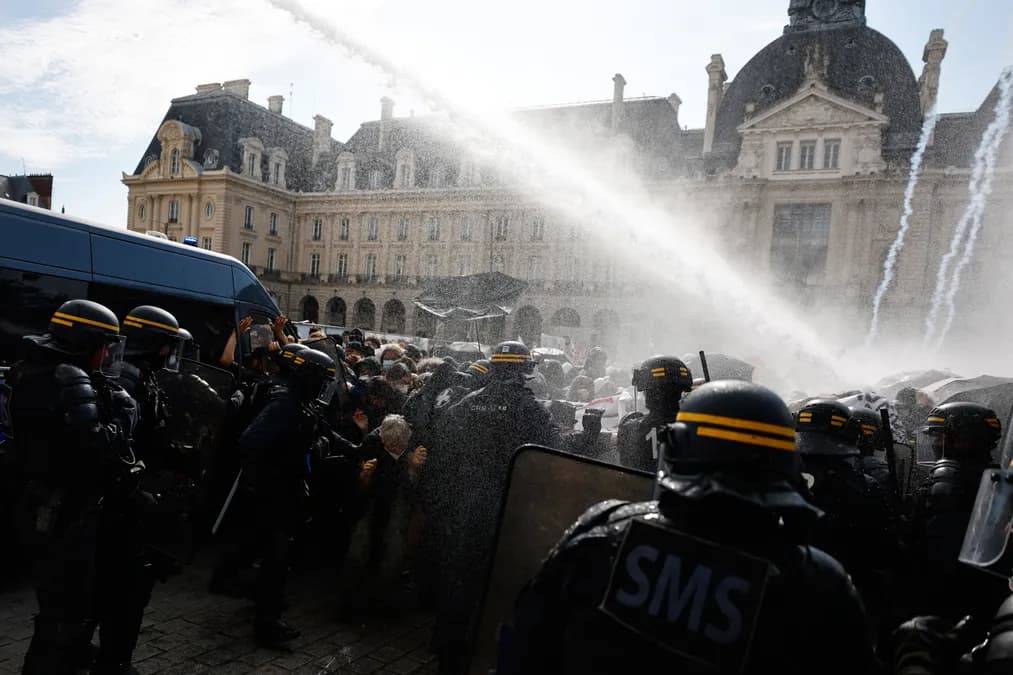
More than a quarter of a million people took to the streets across France on a single day, according to official government figures — a mobilization on a scale that few European democracies have witnessed over an education dispute in recent memory. The protests, which united students, teachers, parents, and union members under a shared demand for greater investment in public schooling, were marked by intensity as well as breadth: authorities recorded thousands of arrests, a figure that functions as a barometer of how far civic frustration had outpaced orderly demonstration.
The scale matters. When a government's own tallies place attendance above 250,000, the standard political deflection — that protests represent only a fringe or a coordinated minority — becomes untenable. What France witnessed was not a campus walkout or a union-specific grievance. It was a cross-generational, geographically distributed expression of alarm about the condition of one of the republic's most sacred institutions: the public school.
The France school funding crisis, as it has come to be called across editorial pages and policy briefs, is not a sudden emergency. It is the visible endpoint of years of deferred decisions, strained budgets, and demographic pressures accumulating beneath the surface of a system long celebrated for its egalitarian ideals.
What Students and Teachers Are Demanding

At the core of the protests is a demand that the French government significantly increase per-student public funding for primary and secondary education. Students have articulated this not merely as a material ask but as a constitutional one — France's founding republican tradition places universal, secular, and free public education at the center of citizenship. When that system deteriorates, demonstrators argue, the social contract itself frays.
Read next Medicaid Work Requirements Strand Cancer SurvivorsTeachers have pressed for smaller class sizes, adequate classroom resources, and salaries that reflect the professional demands placed on educators. French teachers' unions, including major federations that represent primary and secondary school staff, have for years flagged overcrowding and resource scarcity as structural problems rather than temporary inconveniences. Their presence on the protest lines gave the movement institutional credibility and organizational depth.
Students, particularly those in underfunded suburban and rural schools, added a generational dimension. Their argument is straightforward: the quality of education a child receives in France increasingly depends on postcode, and that gap is widening. For a republic that inscribes liberté, égalité, fraternité on its public buildings, the charge carries particular weight.
The thousands of arrests recorded during the protests suggest confrontations with police in some locations. Without editorializing, that number signals a protest environment that moved beyond symbolic marches in multiple cities — an escalation that will shape how the government calculates its political response.
The Roots of France's Education Funding Shortfall

The France school funding crisis did not emerge from a single budget cycle. According to data published by the OECD in its annual Education at a Glance report, France's public expenditure per student at the primary and secondary levels has tracked below the average of comparable Western European economies in recent editions. While France invests substantially in higher education and maintains a large teaching workforce by raw numbers, the per-pupil allocation in its lower and secondary schools has not kept pace with rising costs, inflation, or the specific infrastructure needs of an aging school building stock.
The European Commission's annual education monitoring reports have flagged persistent concerns about classroom conditions in French public schools, particularly in the zones d'éducation prioritaire — the priority education zones established to address disadvantage in high-poverty areas. UNESCO's work on educational equity in OECD member states consistently identifies teacher-to-student ratio and instructional resource availability as leading indicators of learning outcomes, and France's public schools in lower-income areas score poorly on both metrics relative to their private counterparts within the same national system.
France spends approximately 5 percent of its GDP on education — a figure that places it within the OECD mainstream but masks enormous internal disparities between well-resourced lycées in affluent Paris arrondissements and crumbling collèges in post-industrial peripheries. The aggregate number obscures the inequality. Budget consolidation efforts stretching back over a decade have repeatedly targeted education ministry allocations, even as enrollment numbers held steady or grew. The cumulative effect is infrastructure that has aged without adequate replacement, a pay structure that struggles to recruit and retain qualified teachers in hard-to-staff regions, and a cohort of students who experience the gap between France's educational rhetoric and classroom reality every morning.
Government Response and Political Fallout
The government's acknowledgment of the protest numbers — rather than offering a minimized counter-figure — represents a notable concession in how French authorities have chosen to handle the political moment. Confirming that more than a quarter of a million citizens participated does not require a policy commitment, but it does foreclose the option of dismissal.
What follows that acknowledgment is the question that will define the government's credibility on education. Announcing dialogue processes, commissioning reports, or scheduling ministerial meetings are the standard repertoire of governments seeking to absorb protest energy without committing resources. Each of those gestures is likely to be met by the coalition behind the protests — unions, student associations, and parent networks — with heightened scrutiny.
The thousands of arrests complicate the political optics further. Heavy-handed policing of an education protest tends to generate secondary outrage, drawing in civil liberties organizations and opposition parliamentarians who may not share the protesters' specific funding demands but find common ground in criticizing the state's response. That dynamic extends the protest's political lifespan well beyond the day itself.
France's broader fiscal environment adds another layer of difficulty. With budget pressures from debt servicing, defense commitments, and pension reform aftershocks still politically live, the government faces a genuine dilemma: substantive new education funding is expensive, and the revenue space to finance it without cuts elsewhere is narrow.
How France's Crisis Compares to Global Education Funding Debates
France is not alone in confronting a gap between public education ideals and public education funding realities. In the United Kingdom, teacher strikes over pay and resources ran through multiple academic years before government intervention. In the United States, the adequacy of per-pupil public school funding has been relitigated in state courts across dozens of jurisdictions, with plaintiffs consistently arguing that existing allocations fail to meet constitutionally mandated educational standards. Chile, Colombia, and South Korea have all seen major student-led protest movements in the past decade rooted in funding equity.
What distinguishes the French moment is its scale within a single national system and the explicit grounding of demands in republican egalitarianism. The OECD's Education at a Glance data provide a useful comparative lens: countries that consistently outperform OECD averages on learning outcomes — Finland, Estonia, and Canada among them — share a commitment to relatively flat resource distribution across school districts, limiting the variance that France's current system produces. The lesson drawn by French education policy analysts is that aggregate spending levels matter less than distribution mechanisms, and France's distribution currently amplifies rather than corrects social advantage.
What Comes Next for French Schools
The immediate test for the French government is whether it treats the protests as a communications problem or a policy one. A communications response — statements of concern, invitations to dialogue, pledges to review — has a short half-life when confronted with 250,000 people in the streets and thousands detained.
A policy response requires confronting the structural mechanisms that produce the shortfall: the formula by which education ministry budgets are calculated and defended in annual finance law debates, the contractual frameworks governing teacher compensation, and the capital investment program for school facilities. None of those are swift fixes, but each has measurable near-term indicators that protest organizers will monitor.
French teachers' unions have historically demonstrated both the organizational capacity to sustain pressure across academic years and the political sophistication to hold governments to announced commitments. Student associations that mobilized for this protest have a generational stake in the outcome that outlasts any single academic year. The coalition that filled France's streets is not a one-day phenomenon.
What the France school funding crisis ultimately demands is a renegotiation of the fiscal terms on which the republic's promise of equal education is maintained. The students and teachers who marched have made the cost of inaction visible. Whether the political system absorbs that signal or acts on it will determine whether the next major protest is measured in hundreds of thousands — or millions.
Source: NPR Topics: News