Le Pen's Unlikely Bet: Austerity With a Populist Face
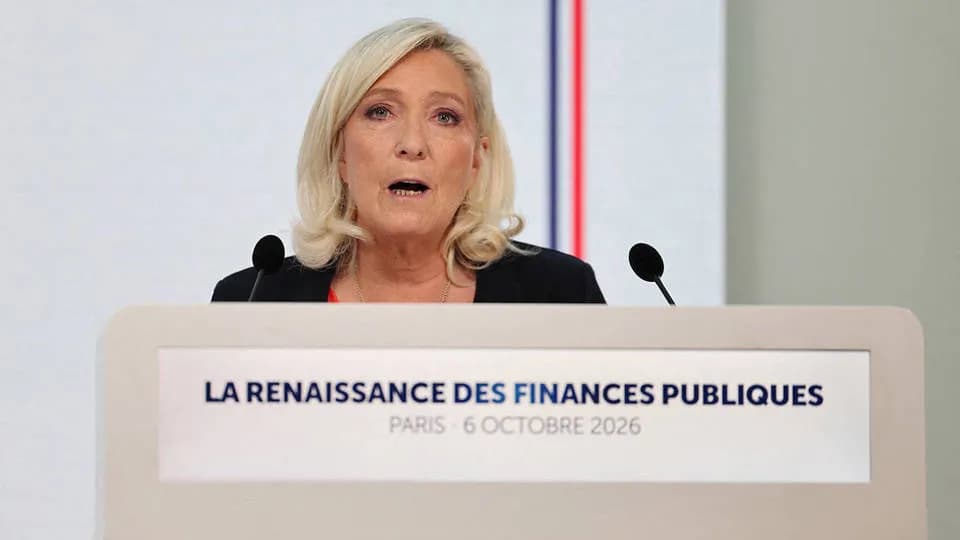
France's public debt exceeded 110% of GDP in 2025, making it one of the most indebted large economies in the eurozone. Against that backdrop, Marine Le Pen recently unveiled an economic program that surprised analysts across the political spectrum: a plan for fiscal consolidation delivered with the full rhetorical force of French economic nationalism. Marine Le Pen austerity as a political product is, on its face, a contradiction in terms — and that is precisely what makes it worth examining closely.
Le Pen's speech detailed what can only be described as populist fiscal discipline: spending restraint packaged not as technocratic necessity but as a patriotic imperative. The state wastes money, this framing goes, not because France spends too much on its people, but because globalist elites, inefficient bureaucracies, and foreign commitments have hollowed out the national budget. Cut the right things, and you serve the nation. This is not the austerity of Jacques Delors or the IMF. It is something stranger and potentially more durable.
Why Fiscal Consolidation Is a Paradox for the Far Right

For most of its modern history, the European populist right has built its electoral coalition on promises of protection: protect jobs, protect borders, protect the welfare state from outsiders who — in this worldview — drain it. Austerity, in the conventional sense, threatens that contract.
Read next France Is Dragging the Eurozone Toward a Debt CrisisPolling data from Ifop and BVA consistently shows that Le Pen's core voter base — provincial working-class France, small business owners in the périphérie — ranks purchasing power and social protection among their top concerns. A 2024 Eurobarometer survey found that 67% of French respondents identified the cost of living as their primary worry, ahead of immigration and security. Any program perceived as cutting pensions, healthcare, or housing subsidies risks severing the emotional bond Le Pen has spent years cultivating.
Research from Sciences Po's Centre for European Studies reinforces this tension. Far-right parties that have shifted toward mainstream fiscal conservatism — whether in Italy under post-Berlusconi coalitions or in the Netherlands under VVD-aligned populist formations — have typically paid an electoral price among their working-class base, even when they gained credibility with financial markets and centrist swing voters. The tradeoff is real, and it is rarely clean.
The Strategic Calculation Behind the Gamble

So why make this move now? The answer likely has more to do with electoral arithmetic than economic conviction.
Le Pen has led the Rassemblement National long enough to understand that winning a presidential election requires crossing a threshold of respectability her base alone cannot supply. In the 2022 presidential runoff, Emmanuel Macron defeated her by roughly 17 percentage points. Exit polling suggested that economic credibility — or its absence — was a decisive factor among the centrist voters who broke against her. She lost not because France rejected nationalism, but because a significant slice of the electorate did not trust her with the budget.
Fiscal consolidation, framed correctly, addresses that weakness directly. It signals seriousness to bond markets, signals discipline to middle-class voters nervous about a debt spiral, and positions Le Pen as a responsible alternative to France's fragmented center-left. The European Council on Foreign Relations has noted that the most electorally durable far-right parties in Europe — Giorgia Meloni's Fratelli d'Italia being the clearest example — have moderated their economic radicalism upon approaching power, trading ideological purity for governing legitimacy.
Le Pen appears to be reading from that playbook. Whether French voters accept the rewrite is another matter entirely.
What This Means for Europe's Broader Nationalist Movement
France is not an island. If this gambit works, it sends a template across the continent. Europe's nationalist right is watching.
Parties from the Sweden Democrats to the Alternative für Deutschland have wrestled with the same dilemma: how to hold a cross-class coalition together while satisfying markets and mainstream commentators who demand fiscal sobriety. Le Pen's move represents the most explicit attempt yet to fuse populist rhetoric with orthodox budget discipline at the scale of a major EU economy.
The stakes extend beyond France. A Le Pen presidency built on credible fiscal management would fundamentally alter the EU's internal balance of power. France and Italy — both governed by nationalist parties with at least rhetorical commitments to consolidation — would present Brussels with a coalition harder to dismiss as economically irresponsible. That is a different Europe than the one that spent the 2010s marginalizing Eurosceptics as profligate dreamers.
Conversely, if the formula collapses — if voters feel betrayed by cuts or markets remain unimpressed — it could set back the far right's claim to governing competence by a decade.
The Risks: How This Could Backfire
The historical record on populist austerity is not encouraging.
Hungary's Viktor Orbán, often cited as a model for nationalist governance, maintained popularity partly by avoiding genuine austerity even while cultivating an image of fiscal nationalism. Poland's Law and Justice party governed with expansive social spending — the 500+ child benefit program was central to its electoral dominance — before losing power in 2023. The pattern is consistent: nationalist governments that have actually cut spending have struggled to sustain their coalitions.
For Le Pen specifically, the risk is a pincer movement. On one flank, cuts to social programs could push working-class voters toward the radical left — Jean-Luc Mélenchon's La France Insoumise has already proved capable of mobilizing that demographic. On the other flank, if the consolidation proves superficial or inconsistent, markets and centrist commentators will call the bluff, and the credibility gain evaporates entirely.
French political economist Bruno Amable, whose work on comparative capitalisms has shaped European debates on fiscal policy, has argued that France's social model is structurally resistant to austerity because so many voters — across the entire political spectrum — are embedded in its institutions. Teaching that electorate to accept cuts while simultaneously promising to defend "real France" against globalism is a feat of political communication that very few leaders have managed.
Verdict: Political Masterstroke or Self-Inflicted Wound?
The honest answer is that no one knows yet.
What is clear is that the logic is sound in outline. The risks are enormous in detail. And the historical precedents offer little comfort to anyone betting on a smooth landing. If Le Pen can hold her base while convincing swing voters that fiscal discipline is a nationalist virtue rather than an elite imposition, she will have accomplished something genuinely novel in European politics.
If she cannot, she will have handed her critics the best argument they have had in years: that far-right populism, when forced to choose between its promises and the arithmetic of a modern welfare state, invariably breaks one or the other.
Europe is watching. The far right is waiting. Marine Le Pen is making the most consequential bet of her career.
Source: Project Syndicate