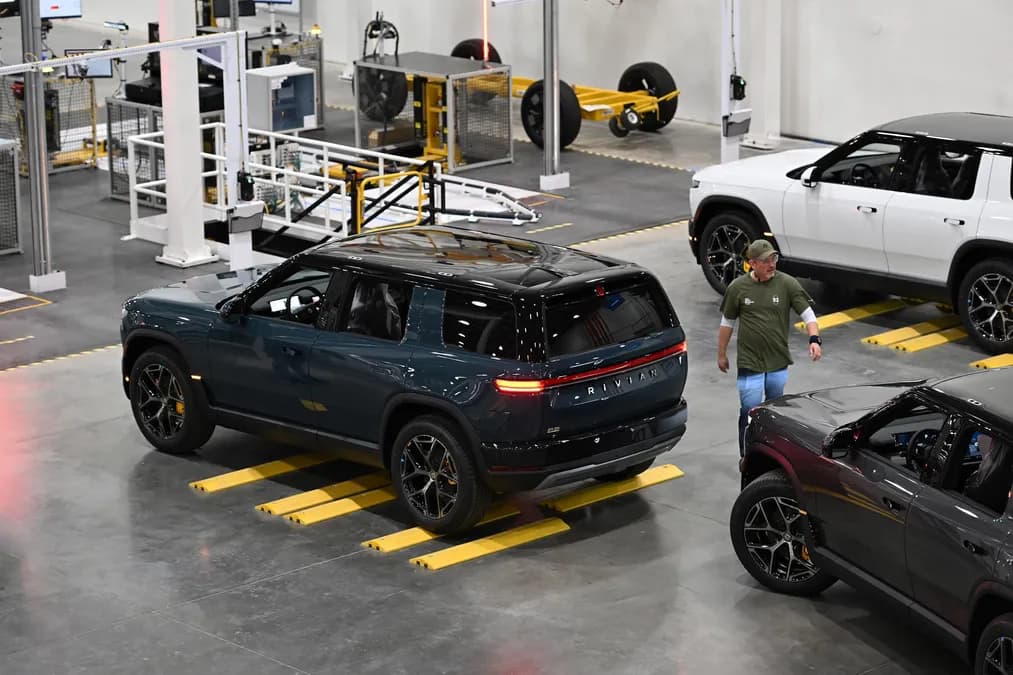
Rivian produced 19,751 vehicles in the third quarter of 2026 and delivered 19,248 of them, according to figures the company released on October 2. The production total marks an 85 percent increase over the same quarter a year earlier, while deliveries rose 45 percent. Those are the strongest year-over-year gains Rivian has posted since it began scaling its consumer lineup, and they arrive less than a year into the ramp of the R2, the more affordable model the company has staked its near-term future on. The early evidence suggests that bet is starting to convert into metal, revenue, and vehicles in driveways.
Rivian Posts Record Q3 2026 Numbers Driven by R2 Demand
The headline numbers alone justify the attention. An 85 percent production jump is not a rounding-error improvement; it reflects a manufacturing base that has moved from erratic single-line output to something closer to sustained cadence. Delivery growth of 45 percent, while smaller, still outpaces most of the legacy automotive sector and much of the pure-play EV field.
For context, Rivian's earlier quarters were defined by the opposite problem: production capacity that ran ahead of its ability to move vehicles to customers. The Q3 2026 figures show a company that has narrowed that gap considerably. A 503-unit difference between what rolled off the line and what reached buyers works out to roughly 2.5 percent of production — a buffer consistent with vehicles in transit, in dealer preparation, or held for quality checks rather than a signal of piling inventory.
The R2 is doing the heavy lifting here. Rivian pitched the vehicle as the model that would widen its addressable market beyond the premium R1T and R1S, and the Q3 numbers are the first large-scale read on whether that pitch holds. So far, the direction of travel is favorable: Rivian R2 sales are climbing alongside output, and the two are moving in step rather than diverging.
Why the R2 Is a Strategic Turning Point for Rivian
Rivian's original business rested on high-price, low-volume trucks and SUVs. That worked as a brand-building exercise but strained the unit economics every quarter, because fixed manufacturing costs were spread across a thin base of deliveries. The R2 changes the math. A cheaper vehicle on the same platform architecture lets Rivian push far more units through its Normal, Illinois plant without proportionally increasing capital outlay.
Read next Laika's Wildwood: Stop-Motion Fantasy at TIFF 2026That is the mechanism behind the 85 percent production figure. Additional volume on an existing line lowers cost per vehicle, which in turn supports the margin profile Rivian needs to reach sustainable profitability. The Q3 delivery number — 19,248 — is the proof point that demand exists to absorb that volume, at least at current pricing.
The strategic logic also matters for how Rivian competes. A company selling only $70,000-plus vehicles competes in a narrow band. A company with a credible mid-market entry can chase fleet orders, first-time EV buyers, and households replacing a gas crossover. The R2's ramp is what allows Rivian to enter those conversations without abandoning its premium identity.
Breaking Down the 85 Percent Production Surge
Scaling output 85 percent year over year is a supply-chain achievement as much as a demand story. Building 19,751 vehicles in a quarter requires consistent delivery of battery cells, semiconductors, stampings, and drivetrain components — and it requires a workforce trained to hit takt time without sacrificing build quality. Rivian's manufacturing team has spent the past several years working through exactly those constraints.
For benchmark purposes, 85 percent year-over-year growth meaningfully exceeds the broader EV segment's pace in most recent quarters. Industry trackers such as the EV Volumes index and analysts at BloombergNEF have generally pegged global EV sales growth in the low-to-mid double digits in 2026, with regional variation. A growth rate four to five times that of the overall market implies Rivian is taking share, not simply riding a rising tide.
That distinction matters for investors. Growth that outpaces the segment suggests product-market fit and execution rather than a favorable macro backdrop. Rivian's production figure is a company-specific result, and the R2 is the company-specific reason.
Deliveries Up 45 Percent: What the Gap Between Production and Deliveries Signals
The 45 percent delivery increase is smaller than the 85 percent production increase, and that divergence deserves a careful read. Mechanically, it means Rivian built vehicles faster than it delivered them this quarter — a pattern common when a new model is ramping, because inventory must be built up in the distribution pipeline before customers can take delivery.
The 503-unit gap is small enough to be read as healthy. Automotive analysts typically treat a production-to-delivery spread in the low single-digit percentages as normal working inventory: vehicles on rail cars, in transit to delivery centers, or awaiting final inspection. A spread that widens quarter after quarter would suggest weakening demand. A spread this narrow suggests Rivian is pacing output to match what the market can absorb.
There is a second read worth flagging. Delivery growth of 45 percent on a production base that grew 85 percent implies Rivian is deliberately sequencing its ramp, building some buffer ahead of anticipated demand rather than chasing output for its own sake. That is the behavior of a company that has learned from the supply shocks of the past few years.
Rivian's Position in the Broader EV Competitive Landscape
The U.S. EV market in 2026 is more crowded and more price-sensitive than it was when Rivian launched. Established automakers have multiple mid-market electric crossovers in production, and newer entrants continue to pressure pricing. Against that backdrop, Rivian's 45 percent delivery growth stands out because it comes without a headline price cut and without a major redesign of the flagship models.
The competitive question is whether Rivian can hold this cadence as rivals ramp their own affordable entries. Analysts who cover the sector have consistently argued that the winners in the next phase of EV adoption will be the companies that can combine brand strength with manufacturing cost discipline. Rivian's Q3 numbers suggest progress on both fronts, but a single quarter does not settle the question.
What the quarter does establish is that Rivian R2 sales are real and material. The company is no longer a premium niche player reporting modest quarterly movement. It is a scaled manufacturer with a mid-market product driving volume.
What These Numbers Mean for Rivian's Long-Term Outlook
The path from 19,751 quarterly vehicles to sustained profitability runs through cost per unit, and cost per unit falls as volume rises. Every additional R2 built on the existing line spreads fixed costs across more vehicles, improving gross margin without requiring new factories. Q3 2026 is the first quarter where that flywheel is visibly turning.
The next milestones to watch are whether the production-to-delivery spread stays narrow, whether delivery growth closes the gap with production growth, and whether Rivian can hold its 85 percent year-over-year production pace into subsequent quarters. Any of those softening would temper the story. None of them softened in Q3.
For now, the numbers tell a straightforward story. Rivian placed a large bet on the R2, and the third quarter of 2026 is the first clean evidence that the bet is paying off. Production is up 85 percent. Deliveries are up 45 percent. The gap between them is small and manageable. In an EV market where execution has separated survivors from cautionary tales, that combination is the one Rivian needed to post.
Source: The Verge