Taylor Swift's 'The Life of a Showgirl' Returns to No. 1 on Billboard 200
The Billboard 200 is not a chart that rewards sentiment. It rewards consumption — measured in album sales, individual track purchases, and streaming activity converted into track equivalent albums and streaming equivalent albums. Ten streams equal one track equivalent unit; 1,250 paid streams equal one album equivalent unit. Every figure is audited, tabulated, and ranked against everything else released or in active circulation that week. When an album climbs back to the summit under those conditions months after its original run, it is not a fluke. It is a deliberate commercial event.
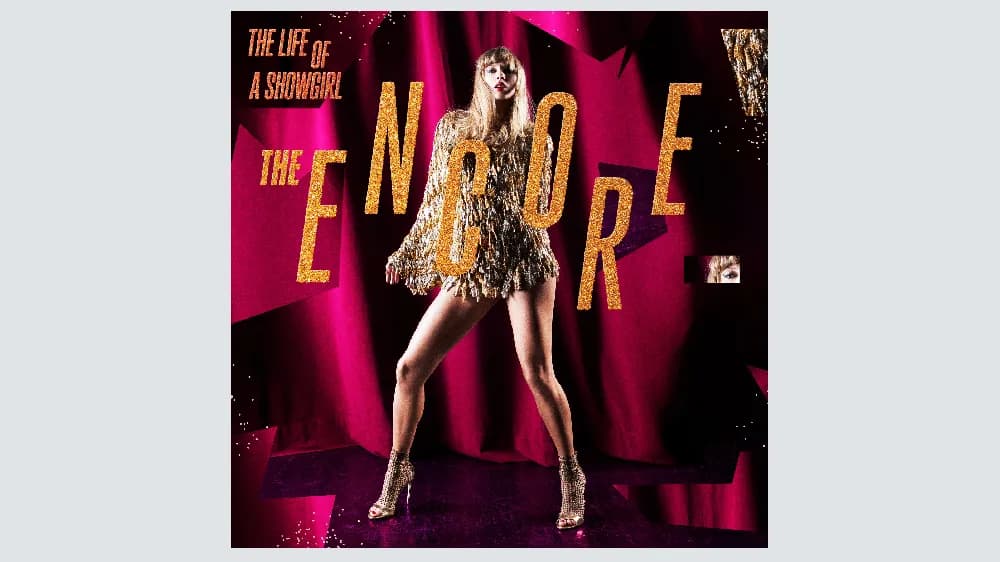
Taylor Swift's "The Life of a Showgirl" accomplished exactly that the week ending in early October 2026, reclaiming the No. 1 position on the Billboard 200 for the first time since January. The mechanism was the release of an expanded version — "The Life of a Showgirl: The Encore" — featuring four new bonus tracks that reset listener engagement, generated fresh purchase activity, and sent streaming numbers surging high enough to displace whatever else occupied the top of the chart. The result: a 13th week at No. 1, a tally that places the album firmly in the conversation about the most dominant releases of the modern streaming era.
Inside 'The Life of a Showgirl: The Encore' Expanded Edition
Four bonus tracks. That is what it took to reignite one of the year's defining albums. "The Life of a Showgirl: The Encore" packages those additions alongside the original tracklist, giving both longtime fans and casual listeners a reason to stream, purchase, and re-engage with an album they may have already absorbed dozens of times. The strategy is precise in its mechanics: new content counts toward the chart's weekly measurement window exactly as original content does. A bonus track streamed a million times is a million streams, indistinguishable in methodology from a track present on the album from day one.
Read next 1963 : le tube yéyé qui a enflammé la France — reconnaîtrez-vous cette voix ?The Encore edition had not been in the market long enough for its full commercial footprint to become clear by the time the chart reset, but its impact on the Billboard 200 was immediate and unambiguous. An album that had spent months outside the top position jumped back over every new release and every chart rival that had been building momentum in its absence. That is a logistical achievement as much as an artistic one — it requires sustained fan infrastructure, a loyal base prepared to re-purchase or re-stream on release day, and a product compelling enough to justify that response.
The Significance of a 13th Week at Number One
Thirteen weeks at No. 1 on the Billboard 200 is not a number that accumulates passively. To reach that total, an album must first debut at No. 1 — or climb there quickly — and then hold that position across multiple measurement windows, fending off new releases that arrive with opening-week promotional machinery behind them. Then it must return, as "The Life of a Showgirl" has now done, when the original chart run ends and a re-release creates a second arc.
For context, the albums in chart history that have reached or exceeded 13 non-consecutive weeks at No. 1 occupy a very short list. Adele's "21" accumulated a historic 24 weeks at the top across two separate runs in 2011 and 2012. Drake's "Certified Lover Boy" and "Certified Boy" era releases demonstrated that the streaming era rewarded catalog depth and artist loyalty as much as debut-week marketing. Michael Jackson's "Thriller" spent 37 weeks at No. 1 in its original run during the album chart's pre-streaming era — a figure incomparable in methodology but useful in spirit when discussing generational commercial dominance. The 13-week mark in 2026, under measurement rules that weight streaming heavily and compress album cycles, is genuinely difficult to achieve.
Taylor Swift's History of Re-Release Chart Dominance
Swift has demonstrated an unusual facility with the re-release as a commercial and artistic instrument. Her Taylor's Version re-recordings — beginning with "Fearless (Taylor's Version)" in 2021 and continuing through several of her earlier catalog titles — were framed initially as acts of creative ownership, reclaiming master recordings from a previous label arrangement. Their chart performance, however, revealed something broader: an audience prepared to treat re-releases as primary listening experiences rather than supplemental products.
"Midnights" in 2022 offered an early preview of the bonus-track playbook in the streaming era. The 3am Edition, released shortly after the original album, added new songs to an already chart-dominant product, extending its consumption window and deepening engagement with an album that had already broken records. The "1989 (Taylor's Version)" rollout in 2023 demonstrated similar dynamics, with vault tracks generating their own chart moments independent of the original tracklist.
"The Life of a Showgirl: The Encore" follows this established pattern but with a notable distinction: the return to No. 1 comes after a gap from the top position. The album had already vacated that spot before the Encore edition arrived. Getting back requires not just fan loyalty but a competitive performance against the full field of releases active during the chart week in question. That the Encore edition achieved it confirms that Swift's audience remains mobilized at a level few artists can access.
What This Means for the Music Industry in 2026
Music industry analysts who track Billboard methodology have long observed that the streaming era fundamentally changed the economics of re-release strategy. Prior to streaming's dominance, a deluxe edition required physical purchase or digital download to register commercially. Today, each stream of each new bonus track generates chart-eligible activity. An artist with tens of millions of monthly listeners can direct that audience toward new content with a single social post and watch the chart effects materialize within days.
The practical implication is that albums no longer have single, terminal release moments. They have phases — original release, deluxe edition, anniversary edition, expanded edition — each representing a fresh chart eligibility window if the artist's audience remains engaged enough to respond. "The Life of a Showgirl: The Encore" is a textbook example of this structure functioning at the highest level of the market.
For labels and independent artists alike, the commercial lesson is instructive. Holding back material for a strategic re-release is no longer just a fan-service decision. It is a chart management tool with measurable results. The gap between January and October — approximately nine months — appears to have been long enough to allow chart fatigue to dissipate while keeping the album in active cultural circulation.
Fan Reaction and Cultural Impact
Swift's fanbase treated the Encore edition's release as an event with the weight of an original album drop. Coordinated streaming campaigns, social amplification, and immediate purchase activity on release day are by now established features of how her audience responds to new material. The four bonus tracks generated immediate discussion across the platforms where music commentary lives — dissecting lyrical content, production choices, and thematic connections to the original tracklist.
The 13th week at No. 1 will register in fan memory as a milestone, another data point in the ongoing project of charting Swift's commercial significance in real time. Thirteen has specific resonance in Swift's public mythology — she has long associated the number with luck and personal significance, referencing it in interviews and incorporating it into her public presence across multiple album eras. Whether or not the Encore edition's release was timed with that numerology in mind, the confluence of the number and the chart achievement will not be lost on the people paying closest attention.
What the Billboard 200 measures, ultimately, is sustained relevance: the capacity of a piece of music to command attention in a market that produces new content at industrial scale every single week. "Taylor Swift The Life of a Showgirl" has now commanded that attention across a 13-week span that stretches from winter into autumn, interrupting the original run and then resuming it months later. That is not a story the chart was designed to tell. It is simply what the numbers say.
Source: Variety