Tesla Rolls Out Emergency Breakaway Feature for Charging Sessions
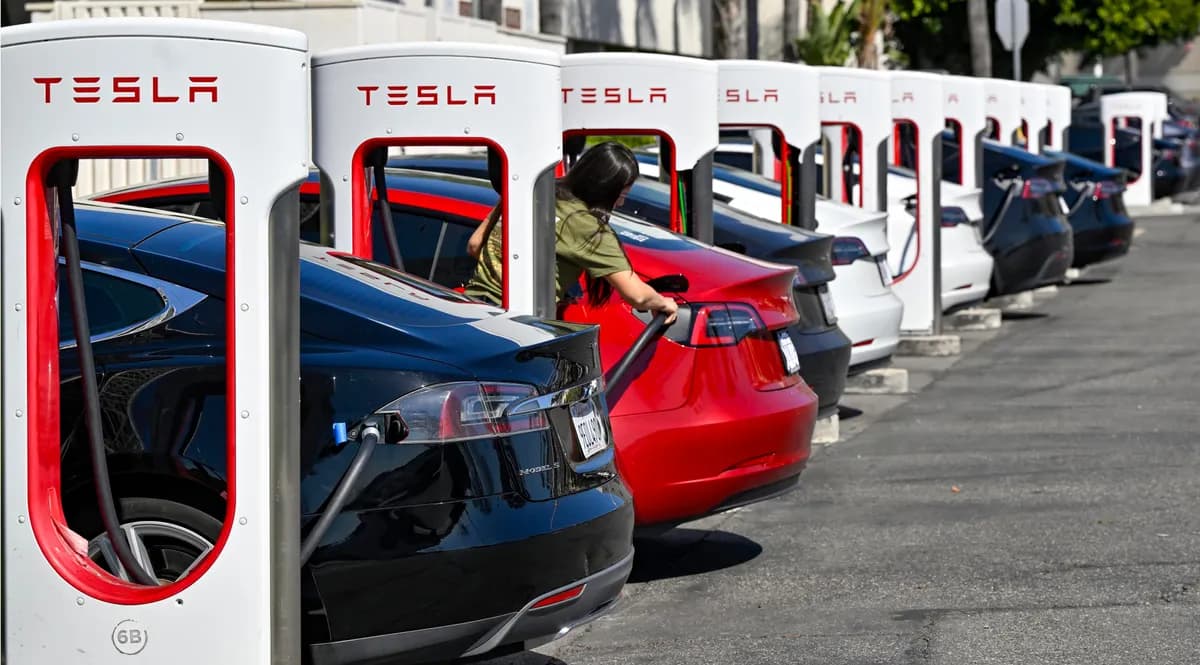
Tesla has introduced a software and hardware response that lets drivers pull away from a Supercharger mid-session when a threat demands immediate flight. The Tesla emergency charging breakaway capability, announced on October 2, 2026, directly addresses a scenario most EV owners have never considered: being trapped in a parked, immobile vehicle precisely when escape matters most.
The scale of the affected fleet is substantial. The U.S. Department of Energy reports that the national charging network has grown past 200,000 public ports, and Tesla's Supercharger network alone accounts for tens of thousands of stalls worldwide, hosting well over a million charging sessions every single day. Every one of those sessions, until now, ended the same way: the driver decided when to leave, or the car did. No third option existed for an urgent exit.
Tesla's change creates that third option. The feature is notable less for its engineering complexity than for what it concedes philosophically: that a safety protocol designed to protect hardware can, in rare circumstances, become a hazard to the human inside the car. The Tesla emergency charging breakaway feature is, at its core, an admission that software rules written for normal conditions must sometimes yield to abnormal ones.
The Idaho Supercharger Shooting That Prompted the Change
In August 2026, a mass shooting at a Supercharger location in Idaho left four people dead and seven wounded. Drivers at the site faced a specific, cruel problem. Their vehicles were plugged in, their charging ports locked, and their drivetrains disabled by design. Getting out meant abandoning the car, or worse, being unable to move it at all.
Read next Laika's Wildwood: Stop-Motion Fantasy at TIFF 2026The Idaho attack was not the first violent incident at a charging location, but its scale made it a turning point. Charging stations are, by nature, transitional spaces — poorly lit in some cases, sparsely staffed, and arranged so that vehicles sit stationary for 20 to 40 minutes at a stretch. That is a long dwell time in an open, often isolated environment. For drivers, the car has always doubled as a refuge. In Idaho, the refuge became a cage.
Tesla's response came roughly two months after the shooting. The company framed the feature as an emergency escape mechanism, tied specifically to the charging state that had previously prevented rapid departure. The timing was not coincidental. It was a direct, if quiet, acknowledgment that the Idaho victims' inability to simply drive away had exposed a gap in how the company thought about charging safety.
The Technical Challenge: Locked Plugs and Disabled Driving
Why can't an EV just drive off while plugged in? The answer sits in the connector standard itself. The SAE J1772 interface, which governs AC charging in North America and informs Tesla's own connector design, includes a locking mechanism that secures the plug to the vehicle's inlet during an active session. That lock exists for good reasons: it prevents accidental disconnection under load, protects against electrical arcing at the contact pins, and stops a live cable from being pulled free and left energized on the ground.
The lock is paired with a second restriction. While charging, the vehicle's drivetrain is typically inhibited. Driving with a cable attached would drag the charger, damage the port, and potentially expose the driver and bystanders to a live conductor. Layered together, the two safeguards create a hard interlock: you are not going anywhere until the session ends or you manually stop it.
The friction is that a manual stop takes time. You must interact with the screen, wait for the plug to unlock, and only then shift into gear. Under normal conditions that sequence costs seconds. Under duress — a shooting, a fire, an approaching threat — seconds are the entire margin.
"The fundamental tension is between protecting equipment and protecting people," said a senior EV safety engineer familiar with charging interlock design. "Every lockout protocol assumes the driver is safe and the hardware is at risk. Emergency egress flips that assumption. The engineering question becomes how fast you can release a lock without creating an arc, and the answer is: faster than most legacy systems were ever designed to."
Tesla's breakaway approach addresses that tension by prioritizing driver exit over session integrity. In an emergency, the car allows the driver to depart even if the charging connection has not been cleanly severed — accepting cable and port risk in exchange for human safety. That is a deliberate trade, and it runs against a decade of design instinct in the charging industry.
What This Means for EV Driver Safety
For the roughly 1.5 million EVs sold annually in the United States, according to Argonne National Laboratory's Assessment of Light-Duty Electric Drive Vehicles, charging is a routine, low-drama activity. Millions of sessions occur without incident. The Idaho shooting was an outlier, and Tesla's feature is designed for outliers.
But outliers define safety culture. Seatbelts, airbags, and emergency door releases all exist for events that most drivers never experience. Charging infrastructure has matured quickly on the electrical and interoperability side — standards like ISO 15118 for Plug & Charge, and the SAE J3400 connector transition — while safety design for the parked, plugged-in human has lagged. Tesla's move puts a spotlight on that imbalance.
The practical effect is significant for drivers who think about personal security. EVs are quieter and less conspicuous than combustion vehicles at idle. In a charging bay, a driver is stationary, seatbelted, and, until now, mechanically committed to staying put. Removing that commitment restores a basic defensive option: leave.
Industry Implications: Should All EV Makers Follow Suit?
Tesla's feature raises an obvious question for the rest of the market. If one automaker enables emergency departure during charging, why not all of them?
The interlock architecture Tesla is working around is shared across brands. CCS, NACS, and CHAdeMO connectors all employ lock pins that engage during active charging. The vehicle-side behavior — disabling drive while plugged — is a common engineering choice, not a Tesla-specific one. Changing it requires coordination between automakers, charging network operators, and the standards bodies that define connector behavior.
There are real constraints. A vehicle that drives off with a cable attached can damage a charger worth tens of thousands of dollars, and a connector energized at 400 to 800 volts is a genuine hazard if mishandled. Any industry-wide emergency release would need fault detection that distinguishes a panic departure from a careless one.
Still, the precedent is set. Safety researcher framing suggests the industry should treat the Idaho tragedy as a prompt to revisit assumptions baked into charging protocols years before mass adoption. Hardware protection has been the priority. Human egress has not.
How to Use Tesla's Emergency Charging Exit Feature
Tesla's emergency charging exit is not a normal operating mode, and it should not be treated as one. It exists for situations where staying parked is more dangerous than leaving.
- Confirm the emergency is real. A false trigger may leave you with a damaged cable, port, or charger, and a repair bill.
- Release and go. The feature is built to allow departure without a normal end-of-session sequence. Expect the plug to disengage abruptly rather than retract cleanly.
- Do not reconnect until the hardware is inspected. Charging a vehicle with a stressed port or cable risks electrical damage.
- Report the incident. Tesla and the site operator need to know when the feature is used, both for maintenance and for safety data.
For now, the feature applies only to Tesla vehicles at Superchargers. That limitation is worth keeping in mind. The problem it solves — being locked in place while charging — is not Tesla-specific. It is an industry-wide vulnerability that one company has started to close.
Source: The Verge