What Is Public Trust in Climate Science and Why It Matters
In 2025, the Yale Program on Climate Change Communication found that 72% of Americans said global warming is happening, yet only 57% understood that most scientists agree it is happening. That gap is not a minor communications problem. It is one of the central barriers between climate knowledge and public action.
Public trust in climate science is the degree to which people believe climate data, climate scientists, and climate institutions are competent, honest, transparent, and relevant to their lives. It is not the same as blind acceptance. Trust is earned when evidence is clear, methods are open, uncertainty is explained honestly, and predictions are tested against what people can observe.
Climate change beliefs shape how people vote, what policies they support, whether they prepare for heat, flooding, wildfire, or drought, and whether they see clean energy as an opportunity or a threat. The science can be strong, but if the public sees climate information as exaggerated, politicized, or detached from everyday concerns, the response weakens.
The Intergovernmental Panel on Climate Change’s Sixth Assessment Report, or IPCC AR6, states that human activities, principally greenhouse gas emissions, have “unequivocally” caused global warming, with global surface temperature reaching about 1.1°C above 1850-1900 levels in 2011-2020. NASA and peer-reviewed consensus studies have long reported that about 97% or more of actively publishing climate scientists agree that humans are causing recent warming. Yet consensus alone does not settle the public debate, because people rarely form climate change beliefs from data alone.
They form them through identity, media habits, economic experience, trust in institutions, and whether climate solutions feel fair.
That is why public confidence matters. Trust determines whether a hurricane forecast leads to evacuation, whether a flood map changes building decisions, whether a farmer believes seasonal risk guidance, and whether a voter sees carbon pollution rules as protection or overreach. Climate science is not only a body of findings. It is a public risk system.
When that system is trusted, societies can prepare earlier and spend less recovering later. When it is distrusted, evidence arrives late, warnings are filtered through ideology, and preventable losses become more likely.
Current State of Public Confidence in Climate Data
The Yale and George Mason University “Climate Change in the American Mind” survey conducted in November 2025 found that 64% of Americans were at least somewhat worried about global warming, including 29% who were very worried. At the same time, 23% believed there is a lot of disagreement among scientists about whether global warming is happening.
Read next How Climate Change Works: A Clear ExplainerThat contrast captures the current state of public confidence: broad acceptance, uneven understanding, and persistent doubt about scientific agreement.
Yale’s “Global Warming’s Six Americas” framework divides the U.S. public into six groups: Alarmed, Concerned, Cautious, Disengaged, Doubtful, and Dismissive. In Fall 2025, 25% of Americans were Alarmed, while 11% were Dismissive. The Alarmed outnumbered the Dismissive by more than two to one. When the Alarmed and Concerned were combined, about 52% of Americans fell into these two pro-action audiences. By contrast, 24% were either Doubtful or Dismissive.
The long-term trend is also meaningful. Yale reports that the Alarmed group grew from 11% in 2015 to 25% in 2025, a 14-point increase. The combined Alarmed and Concerned share rose from 42% to 52% over that decade. The Cautious group shrank from 24% to 17%.
These numbers show that climate concern has deepened, not faded. Still, the public does not move in one block. A person can accept that warming is happening while doubting that it is mainly human-caused. Another may believe the science but oppose a policy because of cost, distrust of government, or concern for workers. Another may be personally worried but silent because they assume their neighbors are not.
That last problem is especially powerful. Yale’s 2025 survey found that most Americans underestimate how worried others are about global warming. This “pluralistic ignorance” can make concern feel isolated even when it is common. If people believe they are in the minority, they are less likely to speak, organize, vote, or support public action.
Public confidence in climate data also varies by type of evidence. Temperature records from NASA, NOAA, Berkeley Earth, and the UK Met Office show clear long-term warming. Satellite observations document shrinking Arctic sea ice. Tide gauges and satellites measure sea-level rise. Attribution science now estimates how climate change affects the probability and intensity of specific events, such as extreme heat waves.
Yet the more local and immediate a claim becomes, the more careful communication must be. Saying that climate change made an event “more likely” is different from saying climate change “caused” it in a simple, single-factor way. The public often hears those statements as interchangeable. Scientists do not.
Trust rises when that distinction is explained plainly.
Key Factors That Build or Erode Climate Credibility
In 2025, Edelman’s Trust Barometer reported that only 36% of respondents globally believed things would be better for the next generation, while the report described a broader “crisis of grievance” toward institutions. Climate science operates inside that larger trust environment.
Several factors build climate credibility.
First, transparency. People are more likely to trust climate data when they can see who collected it, how it was checked, what the uncertainty range is, and whether independent teams reach similar conclusions. The global temperature record is credible partly because multiple institutions using different methods find the same warming pattern.
Second, consistency with lived experience. A person in Phoenix who endures record heat, a homeowner in Vermont facing repeated flooding, or a firefighter in British Columbia confronting longer fire seasons does not need an abstract lecture to understand risk. But lived experience can also mislead. A cold winter week can be mistaken for evidence against warming. Credible climate communication connects short-term weather with long-term trends without overstating either.
Third, independence. Public confidence weakens when people believe data has been shaped to serve political or financial interests. That concern deserves respect, not dismissal. Climate science depends on public funding, university systems, international panels, journals, and agencies. Those systems can have incentives and flaws. The answer is not to pretend they are perfect. The answer is replication, peer review, open data, conflict-of-interest disclosure, and scrutiny from competing research groups.
Fourth, humility about uncertainty. Climate science is strongest when it says what is known, what is likely, what remains uncertain, and what is still being studied. The public often mistakes uncertainty for ignorance. In science, uncertainty can mean a measured range: not whether sea level is rising, but how fast it will rise under different emissions pathways and ice-sheet responses.
Credibility erodes when communicators blur those lines. Overconfident claims about a single storm, exaggerated timelines, or apocalyptic language can backfire. So can selective presentation of evidence. If a source mentions heat records but ignores uncertainty in regional precipitation projections, skeptical readers notice.
Credibility also suffers when climate policy is presented as cost-free. The transition away from fossil fuels creates winners and losers. Coal communities, oil workers, low-income households facing energy bills, and countries still building basic infrastructure all have legitimate concerns. Acknowledging those concerns does not weaken climate science. It strengthens trust by separating physical evidence from policy design.
Katharine Hayhoe, the climate scientist and communicator, has often argued that the most effective climate conversations begin with shared values, not arguments over graphs. Her point is practical: people listen differently when they feel respected.
The Trust Gap Between Scientists and the Public
In Yale’s Fall 2025 survey, 57% of Americans understood that most scientists think global warming is happening, while studies summarized by Yale show that between 90% and 100% of climate scientists are convinced human-caused global warming is happening. That is the trust gap in numerical form.
The gap is not simply ignorance. It is also social distance.
Scientists often speak in probabilities, baselines, confidence levels, and scenarios. The public asks different questions: Will my insurance rise? Is my town safe? Are politicians using this to control my choices? Will my job disappear? Can I trust the people telling me this?
Those questions are not anti-science. They are human.
The IPCC process is designed to assess evidence across thousands of studies, with reports reviewed by experts and governments. To scientists, that makes the findings stronger. To some members of the public, the involvement of governments can make the process seem political. The same feature can build trust for one audience and reduce it for another.
This is where the Yale Six Americas segmentation is useful. The Alarmed want solutions and ways to act. The Concerned want practical information but may not be highly engaged. The Cautious want evidence and reassurance that the issue is real. The Doubtful question causes and seriousness. The Dismissive often see climate science as a political project.
A single message cannot reach all six audiences.
For the Alarmed, repeating “climate change is real” may feel stale; they need credible pathways for action. For the Cautious, extreme rhetoric may push them away; they need clear evidence and local relevance. For the Doubtful, messengers matter. A local meteorologist, military planner, farmer, pastor, doctor, or insurance expert may carry more credibility than a national political figure.
The trust gap also reflects media incentives. Scientific findings usually evolve incrementally. News favors novelty, conflict, and drama. A careful attribution study can become a simplified headline. A caveat can vanish. A model projection can be framed as a prediction. When reality later appears more complicated, distrust grows.
Michael Mann, the climate scientist known for his work on historical temperature reconstruction, has warned that outright denial has increasingly shifted toward “inactivism”: arguments that delay action by claiming solutions are impossible, too expensive, or pointless. That shift matters because it targets people who already accept the basic science but doubt the value of response.
The public may trust scientists on temperature trends while distrusting institutions on policy. Serious climate communication must handle both.
How Climate Misinformation Undermines Confidence
In Spring 2025, Yale found that social media was the most important news source for the Concerned, Doubtful, and Dismissive audiences in its Six Americas analysis. That matters because misinformation does not need to persuade everyone. It only needs to create enough uncertainty to slow action.
Climate misinformation works through several recurring tactics.
One tactic is false balance. A broadcast segment may place one climate scientist against one contrarian, creating the impression of a 50-50 debate even though the scientific literature is overwhelmingly one-sided on human-caused warming. The public sees conflict and assumes uncertainty is much larger than it is.
Another tactic is cherry-picking. A cold month, a local snowfall, or a short-term pause in surface temperature rise is presented as proof against long-term warming. Climate is measured over decades, not days. But isolated examples travel faster than statistical context.
A third tactic is attacking motives. Instead of engaging evidence, misinformation campaigns claim climate scientists are chasing grants, governments are seeking control, or clean-energy advocates are hiding costs. Some institutional skepticism is healthy. Blanket suspicion is corrosive. It makes every dataset look like propaganda before anyone examines it.
A fourth tactic is solution denial. This is increasingly common. The claim is not always “climate change is fake.” More often, it is “nothing we do will matter,” “renewables never work,” “electric vehicles are worse than gasoline cars,” or “China makes action pointless.” Each claim contains enough complexity to sound plausible, but often omits scale, trend, or policy context.
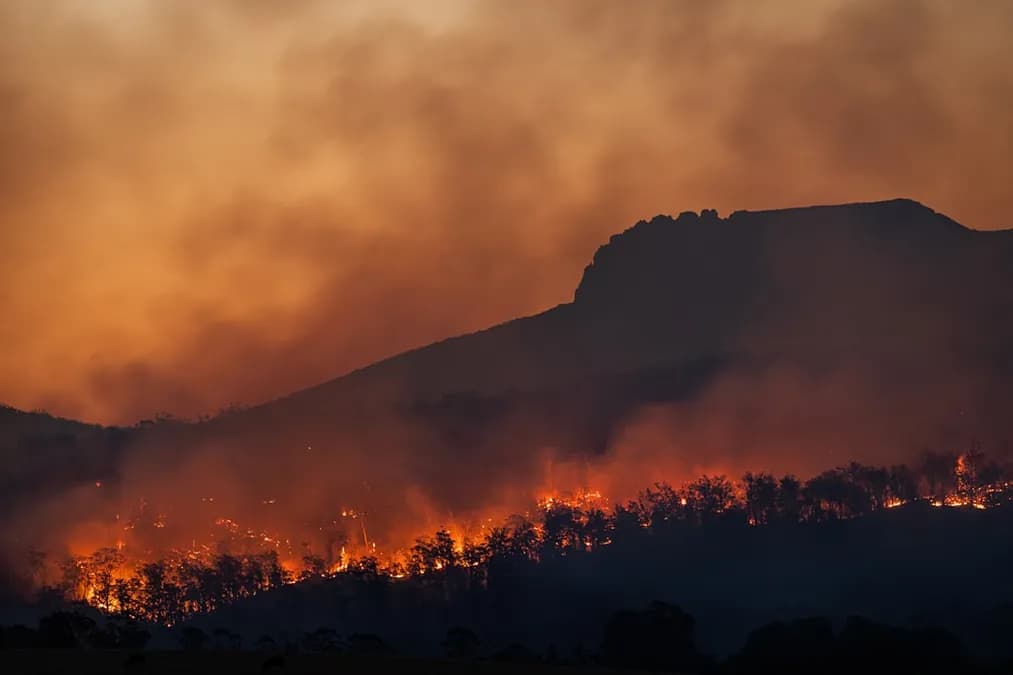
Real-world examples show the cost. During major wildfire seasons in the American West, misleading claims have blamed fires almost entirely on arson or forest management while ignoring the role of hotter, drier conditions in priming landscapes to burn. Forest management matters. Ignition sources matter. Climate also matters. Reducing the story to one cause misinforms the public.
After hurricanes, another distortion appears: either every storm is blamed entirely on climate change, or climate change is dismissed because hurricanes existed before industrial emissions. The accurate account is more precise. Warmer oceans and a warmer atmosphere can increase rainfall intensity, storm surge risk through sea-level rise, and the potential for rapid intensification, though not every aspect of every storm has the same climate signal.
Misinformation also exploits distrust in media. Edelman’s 2025 Trust Barometer found media trust at 52% globally, up 2 points from 2024 but still distrusted in 14 of 28 countries measured. Government trust stood at 52%, business at 62%, and NGOs at 58%. In that environment, people often choose information based on identity and affinity rather than expertise.
The damage is cumulative. If people repeatedly hear that scientists are divided, models always fail, and solutions are scams, their climate change beliefs become less responsive to evidence. Doubt becomes a habit.
Strategies to Rebuild Trust in Climate Science
Yale’s 2025 survey found that 47% of Americans agreed they had personally experienced the effects of global warming, while 44% thought people in the United States are being harmed “right now.” Trust can be rebuilt when communication starts from those lived realities and connects them to evidence.
The first strategy is localizing climate science without distorting it. People trust information more when it relates to their place: heat risk in Houston, flood maps in Miami, smoke exposure in Seattle, crop stress in Iowa, insurance withdrawals in California, or tidal flooding in Norfolk. Local examples make global averages tangible.
The second strategy is using trusted messengers. For many audiences, a climate scientist is credible. For others, trust may come from a doctor explaining heat illness, a firefighter describing fuel dryness, a utility manager discussing grid strain, or a farmer explaining planting shifts. The messenger should fit the audience.
The third strategy is separating science from policy preference. Climate science can say that greenhouse gases warm the planet, that risks increase with additional warming, and that emissions cuts reduce future damage. It does not by itself dictate the exact mix of carbon pricing, regulation, nuclear power, renewables, adaptation spending, or industrial policy. When communicators pretend science mandates one political package, they invite distrust.
The fourth strategy is being direct about costs and tradeoffs. Clean energy infrastructure requires land, minerals, transmission lines, permitting reform, and workforce planning. Some climate policies can raise short-term costs if poorly designed. Low-income households need protection. Fossil-fuel workers need credible transition plans, not slogans. Trust grows when people hear the full ledger.
The fifth strategy is correcting misinformation with care. Repeating a false claim too often can reinforce it. Better corrections lead with the fact, briefly explain the myth, and return to the evidence. For example: “The planet is warming over decades. A cold week does not reverse the long-term trend, just as one hot day does not prove it by itself.”
The sixth strategy is showing accountability. Climate institutions should admit errors, update projections, publish methods, and explain why findings change. Changing a conclusion in response to new evidence is not weakness. It is the scientific method working.
A useful case study is weather attribution science. Early climate communication often avoided linking individual events to climate change. Today, groups such as World Weather Attribution use rapid methods to estimate how warming affected the likelihood or intensity of events. The best studies are careful: they compare today’s climate with a modeled world without human-caused warming, state uncertainty ranges, and avoid claiming more than the evidence supports. This model can strengthen trust because it is timely, transparent, and bounded.
Another case is public health. Heat warnings have become more effective when paired with local guidance: cooling centers, hydration advice, worker protections, and neighborhood-level risk maps. People may argue over global policy, but fewer argue that elderly residents need protection during dangerous heat.
Trust is rebuilt when science helps people make decisions.
The Role of Climate Literacy in Strengthening Belief
Yale’s Fall 2025 data showed that 64% of Americans thought global warming is affecting weather in the United States, including 31% who said it is affecting weather “a lot.” Climate literacy helps people understand what that claim means and what it does not.
Climate literacy is not memorizing carbon-cycle diagrams. It is the ability to understand basic climate mechanisms, evaluate evidence, recognize misinformation, and connect risk to choices. It gives people the tools to assess claims rather than simply accept or reject them.
Several concepts matter most.
The first is the greenhouse effect. Carbon dioxide, methane, and other gases trap heat that would otherwise escape to space. This has been understood since the 19th century and measured in laboratories, satellites, and atmospheric observations.
The second is the difference between weather and climate. Weather is what happens today or this week. Climate is the pattern over decades. A snowy winter day does not disprove warming. A record-hot afternoon alone does not prove it. The trend is the evidence.
The third is attribution. Climate change changes probabilities. It can make some events more likely, more intense, or both. This is similar to how smoking increases cancer risk: it does not mean every cancer case has one cause, but it changes the odds across a population.
The fourth is risk management. Climate action is not based on perfect certainty. Societies buy insurance, build levees, vaccinate, and regulate pollutants under uncertainty because the potential damage is high and prevention can be cheaper than recovery.
The fifth is scale. Individual choices matter culturally and politically, but the largest emissions reductions come from systems: electricity, transportation, buildings, industry, agriculture, and land use. Literacy helps people avoid both helplessness and false simplicity.
Schools, newsrooms, museums, libraries, meteorologists, and public agencies all have roles. So do employers. Edelman has repeatedly found that “my employer” is among the more trusted information sources, though Axios reported from the 2025 Edelman Trust Barometer that employer trust slipped from 79% in 2024 to 76% in 2025. Even with that decline, workplaces remain important channels for practical climate information, especially around heat safety, supply-chain risk, and energy use.
Climate literacy also protects against emotional manipulation. Fear can alert people to danger, but fear without agency can produce denial or exhaustion. Hope without evidence can become empty reassurance. The strongest climate literacy combines seriousness with efficacy: the problem is real, the risks are rising, and choices still matter.
Hayhoe’s communication approach is useful here: begin with what people already care about, then connect climate to that value. For parents, it may be children’s health. For hunters and anglers, habitat. For coastal homeowners, insurance and flooding. For faith communities, stewardship. For business owners, resilience and cost control.
Belief strengthens when climate science becomes personally legible.
Future Outlook for Public Trust in Climate Action
By 2025, Yale found that 25% of Americans were Alarmed about global warming, more than double the 11% who were Dismissive. The future of climate trust will likely be shaped less by whether people have heard of climate change and more by whether institutions can prove that action is fair, competent, and effective.
Several trends point in different directions.
On one side, direct experience is increasing. More people are encountering extreme heat, wildfire smoke, coastal flooding, drought stress, and insurance instability. Yale’s 2025 survey found that 74% of Americans thought global warming is affecting extreme heat at least a little, 72% said the same for wildfires, and 72% for droughts. Experience can make climate risk harder to dismiss.
On the other side, institutional distrust remains a serious constraint. Edelman’s 2025 report found business more trusted globally than government or media, while also warning that grievance toward institutions is rising. Climate action depends on those very institutions: governments to set rules, businesses to deploy technology, media to inform the public, and NGOs to advocate and monitor. If people distrust the messengers, even accurate information struggles.
The politics of cost will also intensify. As climate policy moves from target-setting to construction, permitting, mining, grid expansion, industrial retrofits, and household incentives, opposition will become more concrete. People may support clean energy in general while resisting a transmission line nearby. They may favor emissions cuts but object to higher utility bills. They may trust climate science but distrust a specific program.
That does not mean public confidence is doomed. It means trust must be earned at the implementation stage.
The most durable path forward is evidence plus performance. If heat plans reduce deaths, if flood investments protect neighborhoods, if clean energy lowers bills, if workers see real jobs, and if agencies communicate honestly, public trust can grow. If promises are inflated, benefits are uneven, or costs are hidden, distrust will deepen.
Climate change beliefs are no longer formed in a vacuum. They are shaped by every blackout, insurance notice, wildfire evacuation, utility bill, school heat closure, and infrastructure project. The public is watching not only what scientists say, but what institutions deliver.
The science is strong. The social contract around the science is more fragile.
Rebuilding confidence requires a disciplined standard: tell the truth about risk, tell the truth about uncertainty, tell the truth about costs, and show people that action can protect what they already value. That is how climate science moves from contested information to trusted public knowledge.
Related coverage