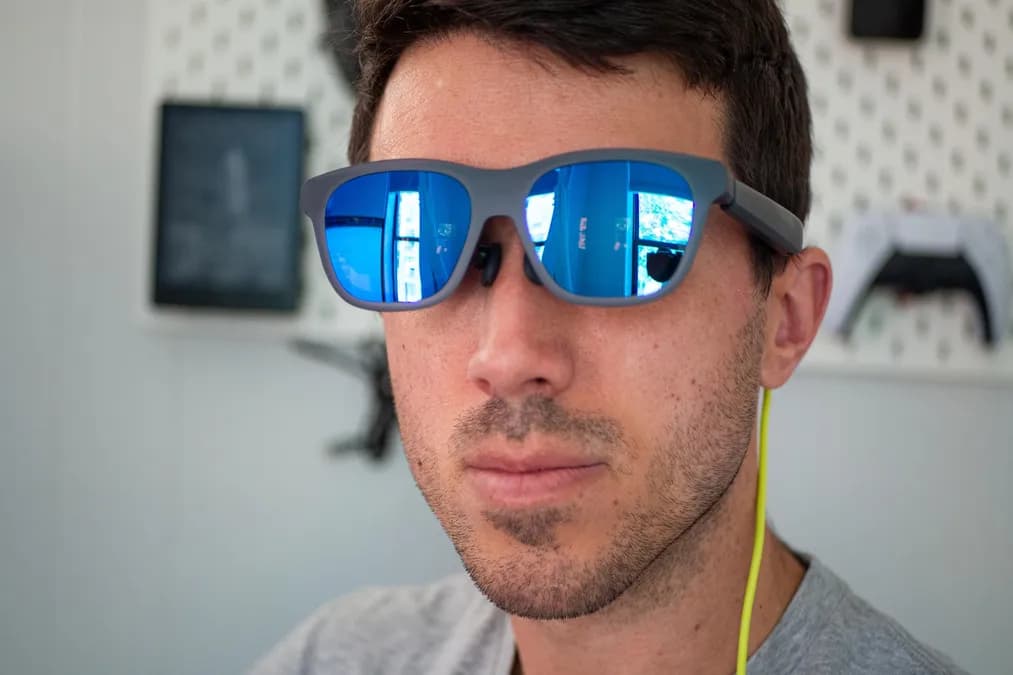
Norway Becomes First Country to Propose AI Glasses Ban
On a Monday in early October 2026, Norway's center-left government announced it would bring legislation to parliament proposing a temporary ban on AI-enabled glasses in specific public spaces. The announcement, delivered by Torgeir Micaelsen, Norway's digitalization minister, marks the first time a major democratic government has moved to formally restrict where wearable AI devices can be used. No other country has progressed this far in legislating against AI glasses specifically, making Norway's proposal a genuine regulatory first.
Micaelsen was direct about his reasoning. "I am concerned about the introduction of powerful new technology where people risk being photographed, filmed, or recorded without their knowledge," he said in a statement accompanying the announcement. The proposed ban is framed explicitly as a precautionary measure — a pause button pressed while a deeper national conversation unfolds. The government simultaneously announced the creation of an expert group tasked with drafting permanent rules, signaling that this is not a reactive ban born of panic, but an opening move in what Norway expects to be a sustained regulatory effort.
The AI glasses ban proposal arrives at a moment when the global smart glasses market is projected by analysts at firms including IDC and Statista to grow substantially through the late 2020s, driven by integration of real-time AI processing, facial recognition capabilities, and persistent camera systems into frames that look increasingly indistinguishable from ordinary eyewear.
Why AI Glasses Raise Serious Privacy Concerns

The privacy challenge posed by AI glasses is structurally different from that of smartphones or security cameras. A camera mounted on a wall is visible and fixed. A phone raised to take a picture is a legible social gesture. AI glasses collapse the distance between the observer and the observed in ways that existing social norms and legal frameworks were not designed to manage.
Read next Laika's Wildwood: Stop-Motion Fantasy at TIFF 2026When a person wearing AI-enabled glasses walks through a public park, they may be passively capturing facial data, environmental details, and audio of conversations within range — all without any visible signal to bystanders. This is the core concern that Micaelsen articulated, and it maps directly onto provisions embedded in the European Union's General Data Protection Regulation. Under GDPR Article 9, biometric data used to uniquely identify a natural person is classified as a special category of sensitive data, subject to stricter processing conditions. The incidental capture of such data by consumer wearables operated in public spaces sits in a legally ambiguous zone that regulators have struggled to address.
The European Data Protection Board, which coordinates GDPR enforcement across EU member states, has previously flagged concerns about continuous surveillance through wearable devices, noting that the combination of AI processing with biometric capture creates compounding privacy risks that exceed those of traditional photography. Digital rights organizations, including the Electronic Frontier Foundation, have documented similar concerns in the context of facial recognition and always-on recording devices, arguing that the asymmetry of information between the wearer and the unwitting subject represents a fundamental civil liberties problem — not merely a technical compliance question.
Norway, though not an EU member, operates within the European Economic Area and has incorporated GDPR into national law. Its proposed AI glasses ban is therefore not operating in a legal vacuum; it is extending an existing framework into territory that EU institutions have not yet explicitly addressed through targeted legislation.
The Locations Targeted by Norway's Proposed Restrictions

The Norwegian government's proposal singles out parks, beaches, schools, and kindergartens as the locations where the temporary AI glasses ban would apply. This selection is not arbitrary. Each of these environments shares a particular characteristic: they are spaces where people — including children — have a reasonable expectation of being unobserved, even though they are technically public.
Schools and kindergartens are the most straightforward case. Children represent a legally and ethically distinct category under both Norwegian law and GDPR, with stricter protections governing how their data may be collected or processed. A device capable of passively recording a playground full of children raises immediate child protection concerns that no reasonable regulatory framework would ignore.
Parks and beaches present a different but equally compelling rationale. These are spaces of leisure and social intimacy — places where people undress, embrace, argue, and relax in ways they would not in a formal public setting. The social contract governing behavior in a beach environment has historically included an expectation that strangers are not documenting each other continuously. AI glasses, worn as casually as sunglasses, challenge that expectation in ways that prior technology did not.
By targeting these specific locations rather than proposing a blanket public ban, the Norwegian government signals a calibrated approach. It is attempting to protect contexts where privacy expectations are highest, rather than overreaching into spaces — city streets, commercial districts — where surveillance has long been normalized.
What Comes Next: Expert Groups and Permanent Rules
The temporary nature of Norway's proposed ban is a feature, not a concession. Micaelsen framed it explicitly as an opportunity: the pause "will give us time to conduct a thorough assessment and hold an informed debate that can lay the foundation for permanent regulation." This framing positions the ban as a deliberate policy instrument — a mechanism for buying institutional time — rather than an emergency measure.
The expert group announced alongside the proposed legislation will carry the weight of producing durable recommendations. The composition and mandate of that group will matter enormously. If it draws on data protection lawyers, technologists, civil society representatives, and child protection specialists, it stands to produce rules with genuine longevity. If it is dominated by industry voices, the resulting framework will face credibility challenges.
Norway's parliament will need to pass the legislation before any restrictions take effect. The center-left government's decision to bring this to parliament, rather than pursuing it through executive rulemaking, reflects both the constitutional requirements of Norwegian governance and a political calculation that public deliberation will produce more durable rules. Parliamentary debate will also surface the likely counterarguments — from technology companies, civil liberties advocates concerned about overreach, and innovation policy specialists who worry about chilling effects on wearable technology development.
Global Implications: Could Other Countries Follow Norway's Lead?
Norway is not a large country, and a proposal from Oslo might under other circumstances be treated as a local policy development of limited international significance. This case is different for several reasons.
First, Norway's proposal creates a policy template that other governments can now reference, adapt, and accelerate through their own legislative processes. The existence of a concrete proposal — with identified locations, a stated rationale, and a parallel expert process — lowers the activation energy required for other governments to act.
Second, the European Union itself is actively developing its regulatory posture on AI through the EU AI Act, which came into force in 2024 and is rolling out in phases through 2027. Norway's targeted AI glasses ban generates real-world regulatory experience that EU institutions, particularly the European Data Protection Board and national supervisory authorities, are likely to monitor closely. If Norway's approach produces workable rules without significant unintended consequences, it becomes harder to argue against analogous EU-level action.
Third, democratic governments in Australia, Canada, and the United Kingdom have each faced growing public and parliamentary pressure to address AI surveillance in public spaces. Norway's move provides political cover — demonstrating that such restrictions are legally achievable and publicly defensible — for governments that have been reluctant to act without precedent.
The United States presents a more complicated picture. Federal privacy legislation remains stalled, and AI regulation proceeds primarily at the state level. But California, which has historically driven US privacy law through statutes like the California Consumer Privacy Act, has shown willingness to act on novel privacy challenges ahead of other states.
What This Means for Consumers and Tech Manufacturers
For consumers, Norway's proposed AI glasses ban signals that wearable AI devices are entering a period of regulatory uncertainty that will vary significantly by geography. A product available for unrestricted use in one country may face real legal constraints in another. This is not unprecedented — facial recognition technology has faced jurisdiction-specific bans and restrictions for years — but the scope of wearable AI adoption means the affected consumer base is far larger.
For manufacturers of AI glasses, the Norwegian proposal is a clear signal that features enabling passive biometric or environmental recording will face scrutiny that cosmetic or fitness wearables have not. Companies that design for compliance — building meaningful consent mechanisms, limiting data retention, providing clear visual indicators when recording is active — will be better positioned to operate across regulatory environments. Those that treat privacy protections as optional features may find themselves navigating an expanding patchwork of restrictions.
Norway has not banned AI glasses outright, and it may never do so permanently. What it has done is force a question that the technology industry has successfully deferred: at what point does the convenience of wearable AI become incompatible with the privacy of everyone nearby? The country's answer — deliberate, temporary, geographically targeted — is not the last word. But it is, for now, the first.
Source: Ars Technica - All content