The periodic table offers many candidates for energy storage chemistry. But iron — element 26, the fourth most abundant element in Earth's crust and a metal humanity has smelted for three millennia — was never supposed to be the answer to the grid's biggest unsolved problem. Form Energy thinks otherwise. The West Virginia–based startup has built a battery around iron that can hold a charge for 100 hours, a duration so far beyond conventional battery technology that it reframes what "energy storage" can mean for the electric grid.
What Is Form Energy and Its Iron-Air Battery?
Form Energy's core innovation is a battery cell that replaces the expensive metals in conventional designs with iron — one of the cheapest and most abundant commodity metals on Earth. The chemistry the company uses is elegant in its simplicity. During discharge, the battery draws oxygen from the surrounding air and combines it with metallic iron, producing iron oxide — rust. That electrochemical reaction releases electrons, which flow as current. When the battery needs to recharge, electrical current reverses the process, stripping oxygen away from the rust and regenerating the original iron metal.
Form Energy calls this "reversible rusting." The phrase is intentionally plain. Where the battery industry often leans on exotic terminology to describe incremental improvements, the Form Energy iron battery trades on a reaction that anyone who has left a lawn mower outside all winter already understands. The chemistry is old; the engineering challenge was making it controllable, rechargeable, and scalable enough to put on a power grid.
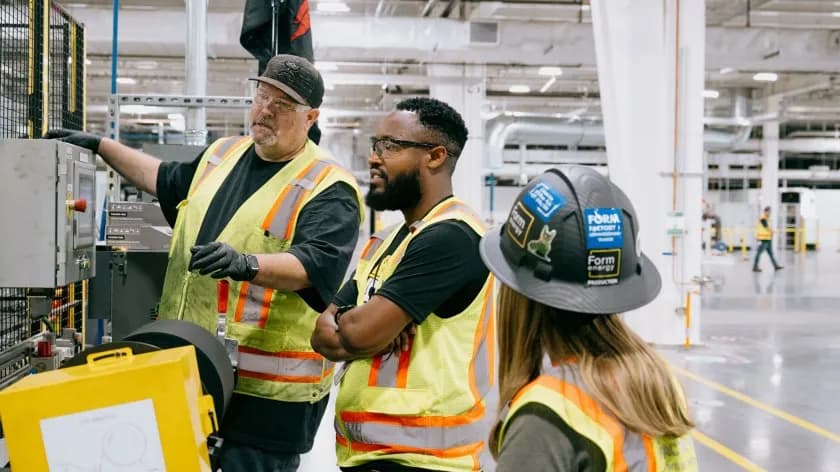
The company has been scaling manufacturing at its Weirton, West Virginia factory, a former steel plant that ties the venture's identity directly to American industrial history. Form Energy has also moved past laboratory demonstrations: it is signing contracts for commercial deployments, translating the technology from the proof-of-concept stage into projects that utilities and grid operators can actually procure.
Why the Grid Needs Long-Duration Energy Storage
Roughly four hours. That is the discharge window for the vast majority of utility-scale battery installations built over the last decade. For years, four to six hours was sufficient, because battery storage was deployed primarily to smooth short-term fluctuations — a brief burst of demand at dusk, a sudden cloud passing over a solar array.
Read next Laika's Wildwood: Stop-Motion Fantasy at TIFF 2026That calculus is changing fast. In leading renewable energy markets, solar and wind now represent substantial fractions of total generation capacity, and their collective output follows patterns governed by physics, not demand curves. The sun sets every evening. The wind calms in certain seasons. A week of overcast skies can suppress solar generation across an entire region for days. The U.S. National Renewable Energy Laboratory has documented in its grid-integration research that as variable renewables push past 30 to 40 percent of generation capacity in a given grid region, the nature of the storage challenge transforms. Short-duration batteries can arbitrage daily price swings. They cannot replace the baseload capacity that a coal or gas plant provides when the wind doesn't blow for three straight days.
The Federal Energy Regulatory Commission has increasingly flagged grid reliability as a central concern as the energy mix shifts. Utilities and independent power producers are beginning to recognize that the two-hour or four-hour storage systems that made sense when natural gas peakers handled multi-day load events become inadequate as those same gas plants retire. What the grid needs in their place is not more of the same short-duration storage — it needs systems that can hold energy from a windy Tuesday and deliver it on a calm, cloudy Saturday.
New solar and wind generation now produces electricity more cheaply than fossil fuels in most regions of the world. That cost advantage is real and durable. But affordability without reliability is an incomplete offer. The missing piece is the ability to shift renewable output across not just hours but days.
Iron Batteries vs. Lithium-Ion: Key Trade-Offs

Lithium-ion batteries are the fastest-growing storage technology in the world, and for good reason. They are energy-dense, proven at scale, and the manufacturing ecosystem built around them for electric vehicles has driven prices down dramatically over the past decade. But the fundamental chemistry of lithium-ion cells creates constraints that grow more problematic as storage durations lengthen.
The cathode materials in most commercial lithium-ion cells — cobalt, nickel, manganese, and lithium itself — are neither cheap nor abundant. According to the U.S. Geological Survey Mineral Commodity Summaries, lithium carbonate prices have seen significant volatility, with periodic spikes driven by EV demand. Cobalt, sourced predominantly from the Democratic Republic of Congo, carries both a supply-concentration risk and a price premium that bears directly on battery economics. Nickel, another key input, trades at commodity prices that are substantially higher than iron by any unit of energy stored.
The cost per kilowatt-hour of storage falls as discharge duration rises — but only if the underlying materials are cheap. A lithium-ion system designed to discharge over 100 hours rather than four would require roughly 25 times the battery capacity to deliver the same energy. At lithium-ion prices, that math simply does not work for most utility applications.
Iron, by contrast, is among the least expensive structural metals on the planet. The Form Energy iron battery accepts a trade-off that is rational for its intended use case: it is heavier and less energy-dense per kilogram than a lithium-ion cell. For a smartphone or an electric car, weight is a critical constraint. For a battery sitting on a multi-acre utility site next to a substation, it is not. What matters there is cost per kilowatt-hour of usable storage, and iron's commodity abundance makes that number structurally lower than any lithium-based alternative at long durations.
The 100-hour discharge capability of the Form Energy iron battery represents not just an incremental improvement but a categorical difference. Four to six hours covers daily cycling. One hundred hours covers multi-day weather events, regional grid stress periods, and seasonal mismatches between peak renewable generation and peak demand. Those are fundamentally different products serving different needs.
Form Energy's Path to Commercial Scale
Manufacturing a novel battery chemistry at utility scale is an engineering and logistics challenge that has ended more than a few clean-energy ventures. Form Energy has chosen to confront that challenge directly by operating its own factory rather than outsourcing production. The Weirton facility is not a pilot line. It is a production ramp-up aimed at generating the volumes required for commercial contracts.
The company is now moving into the contracting phase, signing deals for projects that will deploy its systems at scale. Details on specific counterparties and contract volumes were not disclosed in the reported summary, but the progression from factory ramp to commercial agreements is the standard sequence for any storage technology seeking to establish itself as a procurement option for utilities.
This matters because utilities and grid operators make procurement decisions on long timelines. A storage technology without operating commercial references is a risk too large for most regulated utilities to accept. Each signed contract and each successfully commissioned installation reduces that perceived risk, creating a reference library that accelerates subsequent sales cycles. Form Energy is at the early stages of building that library.
The choice of Weirton is also strategically significant beyond sentiment. Locating manufacturing in a region with a deep industrial workforce, existing heavy manufacturing infrastructure, and access to federal incentives under the Inflation Reduction Act creates conditions for cost-competitive domestic production — a prerequisite for the kind of scale required to matter at the grid level.
Implications for the Clean Energy Transition
The clean energy transition has always had an unresolved tension at its center. Solar and wind generation are now economically dominant in new capacity additions globally. But the grid is an always-on system, and the periods when renewable output runs low are precisely the periods when demand often runs high. Batteries that cover a few hours smooth the edges of that tension; they do not resolve it.
Multi-day storage technologies like the Form Energy iron battery address the structural gap directly. If iron-air systems can be deployed at sufficient scale and at competitive cost, they change the calculus for grid planners evaluating whether a fully renewable system is achievable without firm backup generation. Instead of requiring natural gas or nuclear to cover extended low-renewable periods, operators could draw from an iron battery bank that charged over the previous week's surplus.
That is a large "if." The challenges of scaling novel manufacturing, winning regulatory approval for new storage resources in grid markets, and competing against a rapidly maturing lithium-ion industry are all real. Form Energy is one company at an early commercial stage, not a sector-wide transformation.
But the underlying logic is sound, and the timing is favorable. As variable renewables approach and exceed that 30 to 40 percent threshold in grid after grid, the limitations of short-duration storage become harder to ignore. The market for multi-day storage — a market that barely existed five years ago — is being created by the physics of the energy transition itself. Form Energy is building for that market, using a metal found in the bedrock underfoot, with a chemistry that runs on air.
Source: MIT Technology Review