What Is Solar Energy and How Does It Work
A typical rooftop solar panel can turn 15% to 23% of incoming sunlight into electricity, depending on the technology, temperature, shading, and installation quality. That may sound modest, but sunlight is so abundant that a well-sited home system can cover a large share of household electricity demand.
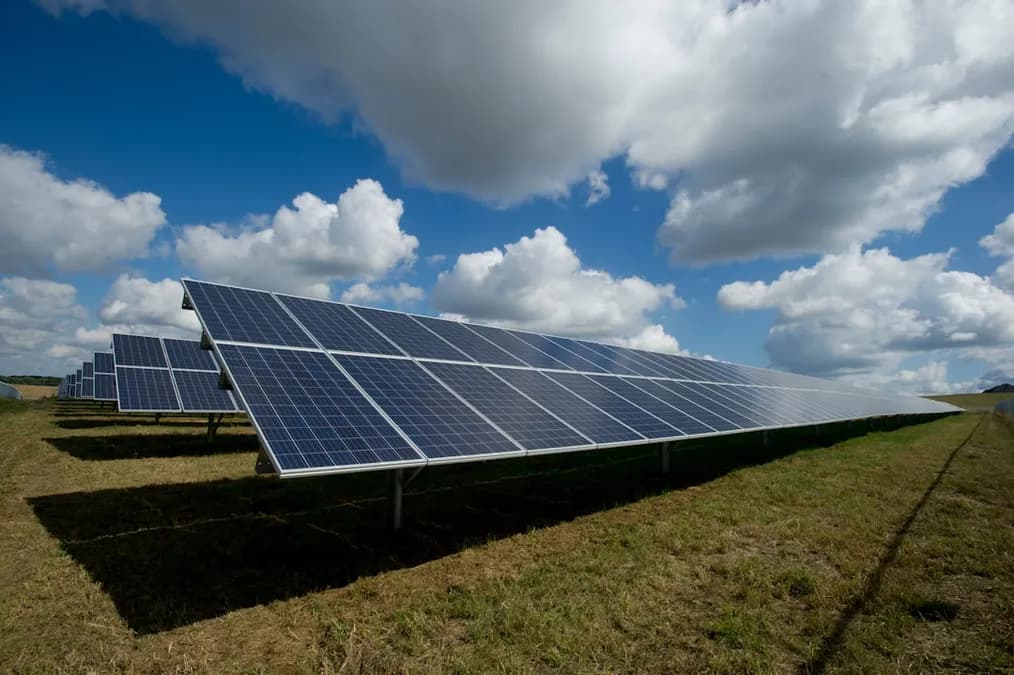
Solar energy usually means photovoltaic power, or solar PV. PV panels are made of semiconductor materials, most commonly silicon. When sunlight hits the cells, photons knock electrons loose, creating direct-current electricity. An inverter converts that power into alternating current, the form used by homes and the electric grid.
There are two main scales. Rooftop solar serves homes, schools, warehouses, and businesses close to where electricity is consumed. Utility-scale solar farms feed larger amounts of power into the grid, often at some of the lowest prices available for new electricity. Batteries are increasingly paired with both, storing midday solar output for evening demand.
Solar thermal systems work differently. They capture heat rather than generate electricity, often for water heating or industrial processes. For most climate and household discussions, though, solar PV is the central technology because it directly replaces fossil-fueled electricity.
Solar Energy's Role in Fighting Climate Change
Electricity and heat production account for roughly a third of global energy-related carbon dioxide emissions, according to the International Energy Agency. That makes the power sector one of the fastest places to cut climate pollution, and solar energy is now one of its most scalable tools.
Read next How Climate Change Works: A Clear ExplainerThe climate case is straightforward: solar panels generate electricity without burning fuel. Once installed, they produce power with no direct carbon dioxide emissions, no methane leakage, and no smokestack pollution. The emissions that do exist come mainly from manufacturing, transport, installation, maintenance, and end-of-life handling.
The IPCC’s Sixth Assessment Report shows that pathways limiting warming to 1.5°C rely on rapid expansion of low- and zero-carbon electricity, including solar and wind. Those scenarios also require steep declines in coal use, major efficiency gains, electrification of transport and buildings, and better land-use practices. Solar is not the whole climate solution. It is one of the largest pieces.
Energy economists often point to solar’s modularity as a major advantage. A coal or nuclear plant can take many years to permit and build. Solar can be deployed as a 6-kilowatt rooftop array, a 5-megawatt community project, or a 500-megawatt power plant. That flexibility helps explain why solar capacity has grown so quickly across very different markets, from California rooftops to Indian solar parks.
Environmental Benefits of Solar Power
NREL’s lifecycle analysis places solar PV at about 20 grams of CO2-equivalent per kilowatt-hour, compared with roughly 820 grams for coal-fired electricity. That gap is the environmental headline: over its operating life, solar power avoids far more climate pollution than it creates.
The benefits extend beyond carbon. Solar generation uses little water during operation, unlike many coal, gas, and nuclear plants that depend on water for cooling. In drought-prone regions, that matters. Replacing fossil generation also reduces sulfur dioxide, nitrogen oxides, particulate matter, and mercury pollution, all of which carry public-health costs.
There are tradeoffs. Solar manufacturing requires mined materials, including silicon, silver, copper, aluminum, and glass. Large solar farms can affect land use and habitat if poorly sited. End-of-life recycling systems are still developing, especially as the first major waves of panels reach retirement.
Good policy can reduce these impacts. Agrivoltaics, for example, combines solar panels with crops or grazing. In parts of Japan, France, and the United States, farmers are testing panels high enough to allow machinery, livestock, or shade-tolerant crops underneath. Brownfields, warehouse roofs, parking lots, irrigation canals, and former mines can host solar without converting intact ecosystems.
The strongest environmental case for solar comes when projects are sited carefully, supply chains are cleaned up, and recycling rules are enforced before waste becomes a large-scale problem.
Global Solar Energy Growth and Climate Goals
The IEA’s World Energy Outlook reports that solar accounted for nearly half of all new electricity capacity added globally in 2023. That is a remarkable shift for a technology that supplied only a small fraction of global power two decades ago.
China has led the buildout, adding record amounts of solar capacity and dominating much of the manufacturing supply chain. The European Union accelerated rooftop and utility-scale installations after Russia’s invasion of Ukraine exposed the risks of fossil fuel dependence. The United States has seen solar become the largest source of new generating capacity in several recent years, supported by federal tax credits, state policies, corporate procurement, and falling equipment prices.
Costs explain much of the momentum. The International Renewable Energy Agency has reported steep declines in solar PV costs since 2010, with utility-scale solar becoming cheaper than new fossil generation in many regions. Once panels are installed, sunlight has no fuel cost. That shields consumers and grid operators from the price spikes that hit gas and coal markets.
But climate goals require more than record installations. The IPCC’s 1.5°C-consistent pathways demand rapid electrification, cleaner grids, and faster retirement or reduced operation of high-emitting fossil plants. Adding solar while fossil generation keeps running at full output will not be enough. The emissions benefit comes when solar displaces coal and gas, supports electric vehicles and heat pumps, and is backed by grids capable of moving clean electricity where it is needed.
A useful case study is South Australia. The state has reached periods where rooftop and utility-scale solar meet most or even all local electricity demand during sunny hours. That success has also forced grid operators to manage voltage, storage, exports, and minimum demand. It shows both sides of the solar story: extraordinary potential and real integration work.
Challenges and Limitations of Solar Energy
A sunny afternoon in California can produce more solar electricity than the grid can absorb, while the same system may need fast-ramping power after sunset. This “duck curve,” documented by grid operators, captures solar’s central challenge: production does not always match demand.
Solar is variable. It depends on weather, seasons, latitude, and time of day. That does not make it unreliable, but it means grids need flexibility. Batteries can shift solar power into evening hours. Transmission lines can move electricity across regions. Demand response can reward consumers for using power when clean supply is plentiful. Hydropower, geothermal, nuclear, and low-carbon fuels may also help balance systems depending on the region.
Grid connection queues are another bottleneck. In the United States and Europe, many proposed solar and storage projects wait years for interconnection studies, upgrades, and permits. The IEA has warned that power grids are becoming a constraint on clean energy deployment. Faster permitting, better planning, and investment in transmission are now climate policy, not just infrastructure policy.
There are equity concerns too. Rooftop solar can save homeowners money, but renters, apartment dwellers, and low-income households often face barriers. Community solar, inclusive financing, and targeted incentives can broaden access. Without those policies, clean energy benefits can skew toward households with capital, good credit, and suitable roofs.
Climate scientists generally stress that solar must be paired with a wider emissions strategy. Energy economists add that market rules must reward flexibility, not just generation. A grid with 40% or 60% solar and wind is possible, but it must be planned differently from a grid built around large fossil plants.
How to Get Started with Solar Energy at Home
A homeowner using 10,000 kilowatt-hours of electricity a year might offset most of that demand with a roughly 7- to 9-kilowatt rooftop solar system, depending on roof orientation, shading, local sunlight, and panel efficiency.
Start with your electric bill. Look at annual consumption, not just one month. Then assess your roof: south-facing roofs are often best in the Northern Hemisphere, but east- and west-facing roofs can still perform well. Shade from trees, chimneys, or nearby buildings can reduce output sharply, so a professional site assessment matters.
Next, compare ownership models. Buying a system usually delivers the strongest long-term savings, especially where tax credits or rebates are available. Loans spread the cost over time. Leases and power-purchase agreements can reduce upfront expense, but homeowners should read escalation clauses, maintenance terms, transfer rules, and buyout options carefully.
Ask installers for production estimates in kilowatt-hours, not just system size in kilowatts. A larger system on a shaded roof may produce less than a smaller system in full sun. Request equipment details, workmanship warranties, inverter coverage, and monitoring access. Reputable installers should explain assumptions clearly.
Battery storage is worth considering if you face outages, time-of-use rates, or weak net-metering compensation. A battery can keep essential loads running and store midday solar for evening use. It also adds cost, so the value depends heavily on local rates and resilience needs.
Homeowners should also improve efficiency before or alongside solar. Weather sealing, insulation, heat-pump water heaters, efficient appliances, and smart thermostats can reduce the system size needed. The cleanest kilowatt-hour is often the one you do not have to generate.
Solar energy is not a cure-all, but it is now a central climate technology: mature, increasingly affordable, and deployable almost anywhere sunlight reaches. For households, it can cut bills and emissions. For the climate, its value grows when paired with storage, stronger grids, fair access, and the rapid decline of fossil power.
Related coverage