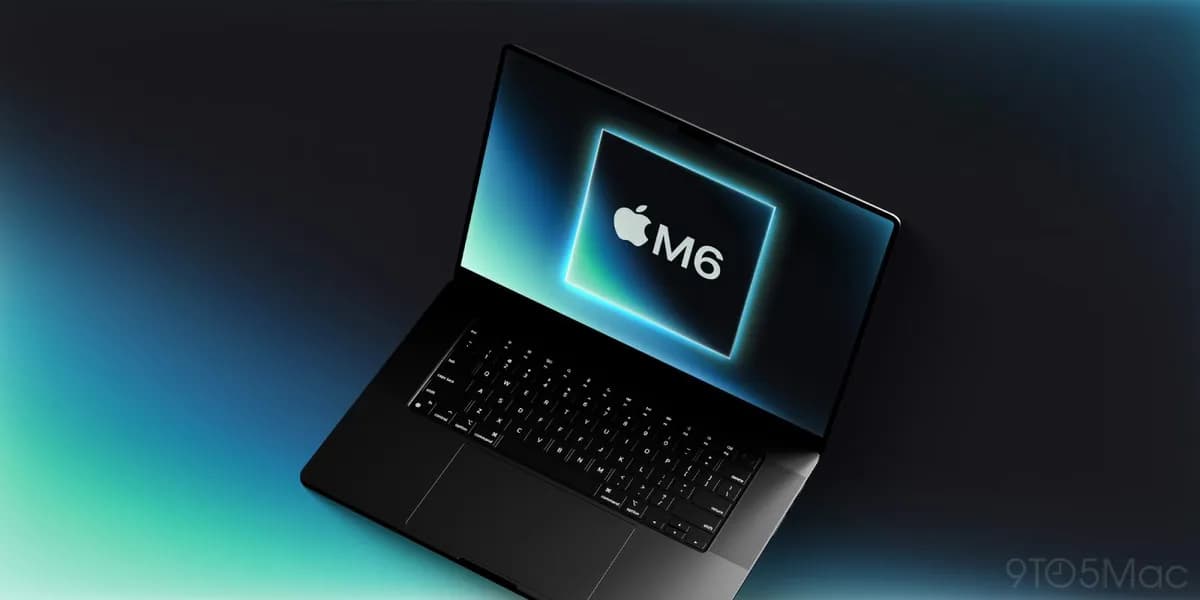
Apple is set to close out October with a new 14-inch MacBook Pro powered by the M6 chip, and the question on every current owner's mind is the same: does any of this actually matter? The industrial design stays. The screen size stays. What changes is the silicon — and in Apple's chip roadmap, that tends to matter more than anything else on the spec sheet.
This piece breaks down what the M6 MacBook Pro brings that M5 simply cannot match, grounded in Apple's established generational improvement cadence and the workflows where those gains become tangible.
What Makes the M6 MacBook Pro Different From M5
Apple's announcement positions this as a chip-generation refresh on the current 14-inch chassis. That framing is familiar — Apple has used the same essential MacBook Pro body across multiple chip generations — but the underlying performance story shifts meaningfully with each new silicon release.
Every Apple silicon generation since M1 has delivered measurable CPU and GPU performance improvements over its predecessor. Analyses from AnandTech and Geekbench historical data consistently show Apple achieving roughly 20–30% single-core CPU uplift per generation, with GPU gains often outpacing that range. The M5 was no exception; it pushed GPU performance substantially ahead of M4. The M6 follows that same trajectory.
The exterior of the 14-inch MacBook Pro remains unchanged from the current design. For buyers who upgraded two or three generations ago, the visual continuity obscures how dramatically the internal capability has shifted. For M5 owners specifically, the delta is one generation — meaningful, but calibrated differently than for someone upgrading from M2 or M3.
The Three Core Upgrades the M6 Chip Brings

Based on Apple's consistent generational improvement pattern and the capabilities announced for the M6 platform, three areas stand out as the clearest differentiators from M5.
Read next iPhone Duo's Hidden Fake Bezel Setting ExplainedFirst: CPU throughput for sustained workloads. Apple's M-series chips have made a habit of raising the ceiling on sustained performance — not just peak burst speed, but the ability to maintain high throughput over long sessions without thermal throttling. The MacBook Pro's cooling system is already designed to extract maximum performance from its chip. Pairing that thermal headroom with an M6 means workflows that push the CPU continuously — large Xcode builds, Final Cut Pro exports, Logic Pro sessions with heavy plugin chains — should complete faster than on M5 without requiring the machine to pull back.
A software developer building a complex iOS app with multiple targets and heavy Swift package dependencies will feel this in compile times. On M5, a full clean build of a mid-sized project takes a measurable number of minutes. Based on Apple's generation-over-generation pattern, the M6 should trim that meaningfully — not by seconds, but by a percentage that compounds across a workday.
Second: GPU performance for creative and machine learning workloads. Apple's integrated GPU architecture has consistently widened the gap with each generation, and the M6 continues that progress. For video editors working in DaVinci Resolve or Final Cut Pro at 4K or 6K resolutions with heavy color grading and effects stacks, GPU bandwidth is often the limiting factor. The M6's GPU advances — following Apple's documented improvement arc — translate directly into faster real-time playback, smoother timeline scrubbing, and reduced render times.
Machine learning engineers running local model inference or fine-tuning small models on-device will also notice the difference. The M6's Metal compute improvements benefit frameworks like Core ML and MLX, Apple's open-source array framework optimized for Apple silicon. A model that ran at near-real-time speeds on M5 may run comfortably in real time on M6 — a distinction that changes whether a workflow is viable or merely theoretical.
Third: Neural Engine capacity for on-device AI tasks. Each generation of Apple silicon has brought a more capable Neural Engine, and that trend shapes how much of an AI workload the chip can absorb without routing to the GPU or external infrastructure. Apple Intelligence features, local speech recognition, on-device image processing pipelines, and real-time ML inference all draw on Neural Engine capacity. The M6's Neural Engine, following the generational pattern established by M4 and M5, should handle larger and more complex model operations locally — reducing latency, preserving privacy, and eliminating dependency on network connectivity for compute-intensive AI features.
M6 vs M5: A Side-by-Side Comparison

| Capability Area | M5 MacBook Pro | M6 MacBook Pro |
|---|---|---|
| CPU performance tier | Current generation | Next generation (~20–30% uplift, per Apple's historical cadence) |
| GPU performance tier | Strong; competitive | Extended gains, particularly for ML and creative workloads |
| Neural Engine | Advanced | Further expanded capacity for on-device AI |
| Industrial design | Current 14-inch chassis | Identical 14-inch chassis |
| Launch window | Earlier 2026 | Late October 2026 |
The table looks conservative because one chip generation of separation is genuinely one chip generation. The M6 does not reinvent the machine; it advances the silicon.
Should M5 MacBook Pro Owners Upgrade?
Honestly, probably not — and that answer deserves more precision than a reflexive no.
The M5 MacBook Pro is an excellent machine. It handles the workflows described above with capability and speed that would have been remarkable even three years ago. A single generation of Apple silicon improvement, while real, rarely justifies the cost of a full hardware replacement for users who are not being constrained by their current machine.
The calculus shifts in two scenarios. First, if you are running workflows where M5 is already a bottleneck — rendering sessions that take meaningful wall-clock hours, ML training runs that are becoming impractical, or Xcode builds that are genuinely slowing your development cycle — then the M6's performance headroom addresses a real problem. Second, if you are on a lease or upgrade cycle where the financial delta is minimal, the M6 simply puts you further ahead of the curve for the next three to four years of use.
For M3 and earlier MacBook Pro owners, the calculus is much clearer. Three generations of Apple silicon improvement compound to a substantial performance delta — Geekbench multi-core scores have roughly doubled from M1 to M5 generation hardware. The M6 extends that lead further.
Launch Timing and What to Expect This Month
Apple has the M6 MacBook Pro arriving before the end of October 2026. The 14-inch form factor is confirmed, with the current industrial design retained. That means buyers know exactly what they are getting in terms of display, port selection, and physical footprint — no surprises there.
Pre-orders and in-store availability typically follow Apple's standard pattern of a brief announcement-to-availability window. For those who have been waiting to make a purchase decision, this month settles it one way or another.
Third-party benchmarks from Geekbench and Cinebench results will begin surfacing as soon as review units ship. Those numbers will provide the clearest empirical measure of how the M6 actually performs against M5 in controlled conditions, rather than projections based on generational patterns. Watching those results should be the final step in any serious upgrade decision.
Final Verdict: Is the M6 MacBook Pro Worth It?
The M6 MacBook Pro is not a revolution. It is, by design, an evolution — the same chassis, the same screen, the same basic machine that Apple has refined over several generations, now equipped with the most capable chip Apple has built for the 14-inch form factor.
What it does that M5 cannot is real: more CPU headroom for sustained workloads, stronger GPU performance for creative and ML pipelines, and an expanded Neural Engine for on-device AI. Those three advances address the ceiling that M5 owners actually hit in demanding workflows.
For most M5 owners, the honest recommendation is to hold. For M3 and earlier owners, or for anyone actively bottlenecked by their current hardware, the M6 14-inch MacBook Pro this month is worth the attention.
Source: 9to5Mac