Why Trump Wants to Rename Artificial Intelligence
When President Donald Trump announced plans to rebrand artificial intelligence as "super intelligence," the reaction from most observers ranged from bemused to skeptical. The label carries obvious appeal for a president who has long favored grandiose framing. "Artificial" implies something manufactured, contingent, perhaps second-rate. "Super" implies dominance, scale, American exceptionalism. That distinction is not accidental.
The super intelligence rebrand is, at its core, a branding exercise in the presidential mold — language as territory. It mirrors the logic behind renaming federal agencies or rechristening geographic landmarks. By attaching a new term to a technology with enormous economic and geopolitical stakes, the administration signals ownership. The question is whether ownership of a word translates to ownership of the narrative, and whether Silicon Valley's most influential players will help enforce that translation.
Which Silicon Valley Leaders Are Adopting the New Term
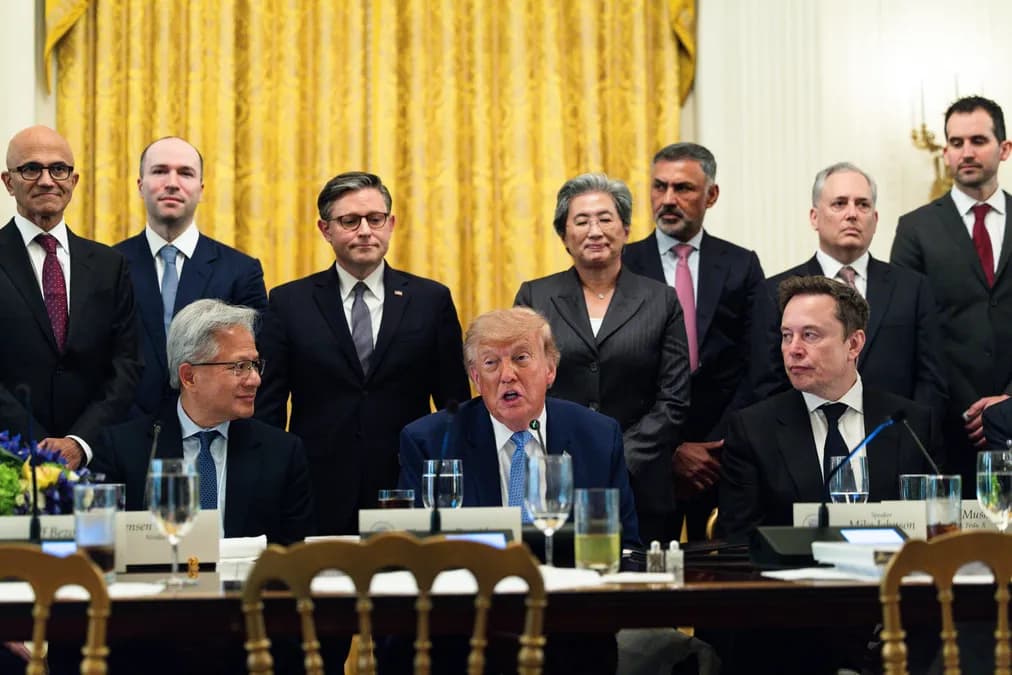
Not everyone in the technology industry dismissed the rebrand. As reported, some of Silicon Valley's most powerful figures began falling in line, attempting to give the administration the linguistic victory it sought. The pattern is telling. These are not obscure figures nodding to a presidential preference — they are individuals with direct financial exposure to federal contracts, regulatory decisions, and administration goodwill.
Read next Laika's Wildwood: Stop-Motion Fantasy at TIFF 2026The adoption is strategic and selective. Data scientists, academic researchers, and open-source contributors are not reaching for "super intelligence" in peer-reviewed literature or technical documentation. The term circulates among executives and investors — people for whom proximity to power carries material value. That is a meaningful distinction. The super intelligence rebrand is not spreading through the language organically; it is being carried by those with something to gain from carrying it.
The sorting function is already visible. The broader engineering community, university researchers, national lab scientists — they continue using "AI" without apparent hesitation. The rebrand separates those angling for access from those operating outside that calculus entirely.
What a Rebrand Actually Signals in Tech Politics
Linguists who study institutional language have long observed that terminology shifts in policy contexts rarely emerge from neutral semantic evolution. They emerge from power. When the Department of Defense began preferring "kinetic operations" over "combat," or when "quantitative easing" displaced "printing money" after 2008, the terminology choice was doing ideological work — managing connotation, managing public affect, managing accountability.
The super intelligence rebrand operates on identical logic. Observers of Washington-Silicon Valley relations have noted that vocabulary alignment functions as a low-cost loyalty signal. You don't have to donate to a campaign or take a public position on contentious policy. Use the president's preferred term in an earnings call or a press interview, and the alignment is registered. It costs almost nothing. It signals almost everything.
Tech-policy analysts have described the dynamic as "lexical clientelism" — where access to a powerful patron is maintained partly through mirroring their language. When enough influential voices adopt a term, it acquires gravitational pull that draws others in, even reluctantly. The effect is cumulative and self-reinforcing.
The Gap Between Industry Insiders and the General Public
Google Trends data consistently shows that public search interest remains anchored to "artificial intelligence" and "AI." Pew Research Center surveys on technology familiarity find that a substantial majority of Americans recognize "AI" as a term, while awareness of "super intelligence" as a distinct rebrand of the same technology remains negligible outside politically attuned circles.
This gap matters structurally. The super intelligence rebrand faces a challenge that executive vocabulary alignment cannot solve quickly: "AI" is already embedded in product names, marketing copy, regulatory filings, academic literature, and everyday conversation. A rebrand confined to a politically adjacent executive class becomes a shibboleth rather than a lingua franca — a password, not a language.
That distinction shapes what the rebrand can and cannot accomplish. It can signal affiliation. It cannot, at least not yet, reshape how most Americans understand the technology. Companies navigating both political favor and consumer communication must effectively code-switch — calling their product "super intelligence" in a White House briefing while marketing it as "AI" to consumers. That friction has its own costs.
Historical Precedents for Technology Rebranding
History offers instructive cases. "Cloud computing" did eventually displace the earlier vocabulary of "hosted services" and "on-demand computing" in mainstream usage — but it required roughly a decade. The term emerged around 2006 and 2007 through Amazon Web Services and later Google and Microsoft. By the mid-2010s, public recognition was widespread, if imprecise. Crucially, that transition succeeded because it was driven by product launches, marketing spend, and broad industry consensus — not by political mandate.
"Machine learning" follows a different arc. Researchers had used the term since the 1950s, but it only entered mainstream press coverage reliably after 2014, when deep learning breakthroughs made it commercially newsworthy. Even then, the broader public still conflates it with "AI" interchangeably. Precise technical vocabulary diffuses into mass usage slowly and unevenly under ideal conditions.
The super intelligence rebrand starts from a weaker position than either precedent. It is politically motivated rather than technically or commercially motivated. It lacks the product-launch momentum that drove "cloud" into mainstream consciousness. And it faces an entrenched competitor — "AI" — that is not merely a technical term but a cultural object embedded in decades of science fiction, news coverage, and consumer brand identity.
What This Loyalty Test Means for AI Governance
The stakes extend well beyond language. The super intelligence rebrand touches directly on governance — on who gets consulted when regulations are written, who lands federal AI contracts, and whose technical standards shape national policy. If using the president's preferred terminology functions as a condition of access, then policy conversations become filtered through that condition. Participants who want a seat at the table face implicit pressure to adopt not just the vocabulary but the worldview the vocabulary encodes.
This is where the loyalty test framing sharpens into something analytically serious. Rebrands that function as tests are not neutral semantic experiments. They are mechanisms for sorting allies from non-participants, identifying who has opted into the administration's framework and who has stayed outside it. In a policy environment where AI governance decisions — national security applications, procurement rules, export controls — carry multi-billion-dollar consequences, the cost of remaining outside that framework is material.
The super intelligence rebrand will not succeed in the way the administration might hope. The general public won't follow. The technical community won't follow. Global counterparts won't adopt it. But mass adoption isn't required for the test to function. It only needs to sort the room. On that narrower measure, there is already evidence it is working — and that, not linguistic victory, may have been the point from the start.
Related coverage
- Trump's Super Intelligence Order: CEO Summit Explained
- Trump Signs Super Intelligence Order; CEOs Take AI Pledge
- Trump Bans 'AI' Term — Only 'Super Intelligence' Allowed
Source: The Verge