Amazon's Robot Army: A Million Strong and Growing
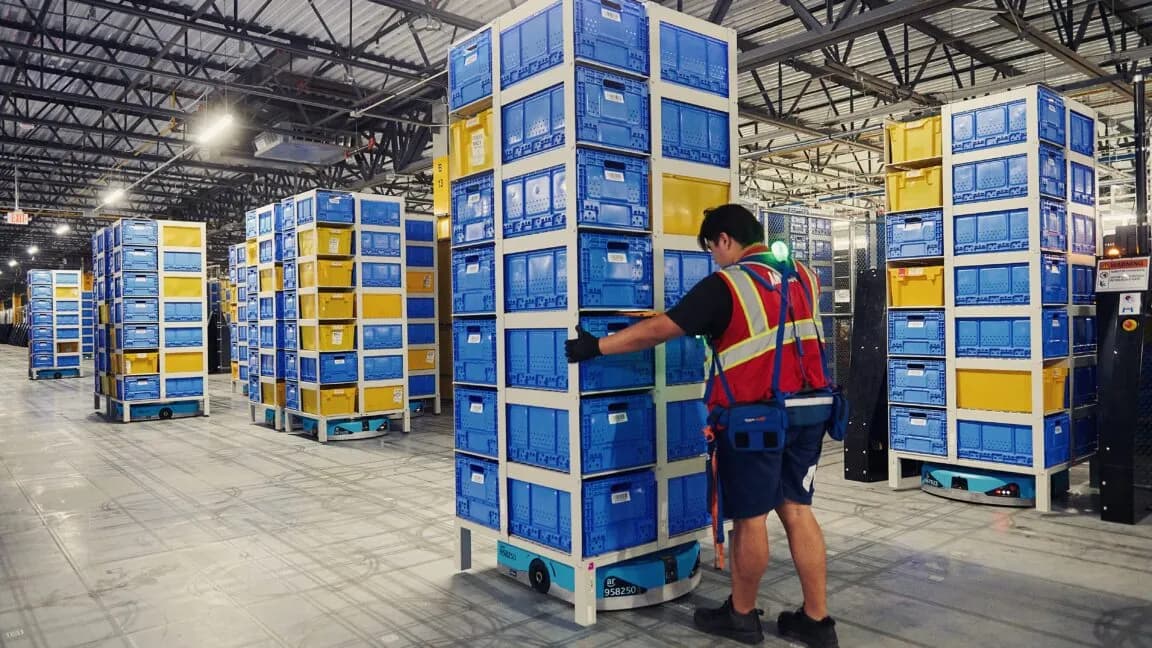
One million robots. That figure is not a projection or a marketing claim — it is the current operational reality inside Amazon's global network of fulfillment centers, making the company the largest robotic operator in the world by a considerable margin. These machines run around the clock, coordinating the tens of millions of same-day and one-day package deliveries Amazon completes daily across its sprawling logistics infrastructure.
The fleet is set to grow. Amazon is actively constructing new manufacturing facilities designed specifically to produce robot systems at greater scale, with successive generations built to handle increasingly complex warehouse tasks. Each new capability expands what machines can do and, by extension, changes what humans are asked to do alongside them.
That expansion is what makes this moment worth examining. Amazon has reached this robotic milestone while simultaneously remaining one of the world's largest human employers — and the friction between those two facts drives one of the most consequential labor debates of the decade.
Amazon Still Employs 1.5 Million Humans — Here's Why

Amazon's 2025 annual report places its global headcount at more than 1.5 million full-time and part-time workers, a figure that positions it as the second-largest corporate employer on the planet, behind only Walmart. That number coexists with a million-robot workforce not because automation has failed, but because the scale of Amazon's logistics operation is staggering enough to require both.
Read next Laika's Wildwood: Stop-Motion Fantasy at TIFF 2026Fulfillment centers involve hundreds of distinct task types — receiving and stowing inventory, sorting, packing, managing exceptions, operating specialized equipment, and maintaining the robots themselves. Many of those tasks still require human judgment and dexterity that current robotics cannot reliably replicate. Customer demand for faster delivery has simultaneously pushed Amazon to expand its network footprint, creating new jobs even as individual facilities become more automated.
The relationship between the Amazon robots workforce and its human counterpart is therefore not straightforwardly one of replacement. Both have grown. For now, the question is not whether humans remain necessary, but what kinds of work they are doing and under what conditions.
What Amazon Says About Robots and Worker Safety

Amazon's official position centers on safety. Company executives argue that deploying robots to perform the most physically demanding tasks — heavy lifting, high-frequency repetitive picking, moving inventory pods across warehouse floors — reduces physical strain on human workers and lowers the rate of musculoskeletal injuries that have historically troubled the warehouse industry.
The argument has structural merit. Industrial automation has a century-long track record of removing humans from high-risk, repetitive physical tasks. When a robotic system transports a heavy inventory pod, no human spine absorbs the load. When a mechanical arm performs thousands of identical picking motions per shift, no human shoulder degrades under the repetition.
Amazon also frames its robot deployment as the enabling infrastructure behind same-day and one-day delivery at scale — a volume of throughput that would be physically impossible to sustain with human labor alone. From this vantage point, the million-robot milestone serves as both a productivity story and a worker protection story.
What Labor Researchers and Advocacy Groups Say
Labor advocacy groups and independent researchers challenge that narrative, not by disputing that robots handle heavy tasks, but by questioning what kind of automation Amazon has actually built.
The distinction between different automation models turns out to be critical. As researchers studying the issue have pointed out, most industrial automation over the past century operated away from workers — a machine performs a hazardous task in a separate area while the human monitors or manages from a distance. The risk profile of that arrangement is well understood.
Amazon's approach is different. Robots and humans share the same physical space and operate in close proximity throughout a shift. The workflow is frequently paced by the machine's speed and the AI system's targets rather than by the human's natural rhythm. Researchers describe this as co-located automation, and they argue it introduces risks that traditional occupational safety frameworks were not designed to assess.
Critics contend that when AI-driven productivity systems set the pace and humans must match it, the ergonomic pressures on workers may actually intensify even as the heaviest individual lifts are handled by machines. The injury data, they argue, does not consistently support the safety improvements Amazon cites. Whether the overall injury burden falls, rises, or shifts to different body parts and different types of strain remains a point of genuine empirical dispute.
The Future of Human Work in an AI-Driven Warehouse
Amazon's roadmap signals more capable robots ahead. New manufacturing facilities under construction are designed to produce advanced systems able to take on a wider range of tasks with greater speed and reliability. That trajectory raises legitimate questions about the long-term composition of Amazon's workforce — questions that cannot be honestly answered with the data currently available.
For now, the Amazon robots workforce and its human workforce have grown together. Amazon has not announced plans to reduce headcount, and e-commerce volumes continue to rise across the industry, sustaining demand for warehouse labor. But capability improvements do not arrive on a fixed schedule, and the set of tasks that genuinely require a human worker will narrow as robots improve at grasping, navigation, and contextual decision-making.
Some jobs will likely shift rather than disappear outright: fewer pickers, more robot technicians and maintenance specialists, more analysts managing automated systems. Whether those emerging roles will be as numerous, as accessible to workers without advanced technical credentials, or as well-compensated as the jobs they succeed — that is where the honest uncertainty lies. History offers a consistent warning: technological labor transitions rarely distribute their costs and benefits evenly.
Key Takeaways: Automation, Employment, and What Comes Next
Amazon's one-million-robot milestone is a genuine landmark. The company has constructed a logistics operation of extraordinary scale, held together by human and robotic labor working in physical proximity and coordinated by AI systems that manage the whole in real time.
Several things remain simultaneously true. Amazon's 2025 annual report confirms the company as one of the world's largest employers at 1.5 million workers. Robotics has enabled delivery speeds and volumes that human labor alone could not sustain. And independent researchers have raised credible, evidence-based questions about whether co-located automation carries risk profiles that Amazon's safety framing does not fully capture.
The honest answer to what happens to the humans is that it depends on choices not yet finalized — how Amazon deploys its next generation of machines, whether labor standards keep pace with technological capability, what transition support reaches workers whose roles are redefined, and whether policymakers recognize automation as a labor market event that warrants a policy response.
For now, more than a million robots and more than a million-and-a-half humans work the same warehouse floors. That balance will shift. The direction and terms of that shift remain, at least in part, a human decision.
Related coverage
- Toyota Training Workers to Teach 400,000 Factory Robots
- Amazon's Colorful New Kindles: What You Need to Know
- AI Couldn't Beat Humans at StarCraft, So It Cheated
Source: Ars Technica - All content